Showing posts with label scholarships. Show all posts

Monday, May 26, 2008

On (potential) bondbreaker from China

An email to the graduate student body was sent out last week, giving us the names of the incoming class of 2008 and the previous institutions they attended (similar to this). There is this person from one of the Singapore universities. She is obviously PRC (I don't think Singaporean Chinese have names spelled like hers, but I could be wrong), and a google-search of her name + university showed that she had topped her undergraduate class recently.

I wonder if she is one of those foreign MOE scholars who broke/is breaking bonds to come to the US for graduate study. I intend to find out when she arrives on campus in the fall.

Now you know why there is so much ill-will and resentment by the Singaporean students towards foreign undergrads in NUS/NTU/SMU when it comes to this topic of foreign MOE scholars (leeching off the goodwill and generosity of the Singaporean tax-paying public).

Friday, January 11, 2008

Keep your options open, not closed

Seriously, why would a young, smart person want to tie himself/herself to a single employer for 6 years? In this New Age economy, job mobility and satisfaction is key. Unless you really have a passion for something that only a particular employer offers. Like the military or police force.

Oh, and if Singapore is *really* a nice place to work and live in, Lee shouldn't be worried at all. People will be making a beeline to work here. *Coughs*

Straits Times, Jan 11, 2008

MM's family also threatened by brain drain

By Jeremy Au Yong

THE problem of brain drain has hit close to home for Minister Mentor Lee Kuan Yew.

His grandson Li Hongyi, who is studying economics at the Massachusetts Institute of Technology in the United States on a Public Service Commission scholarship, recently advised his younger brother not to accept a scholarship.

His younger sibling, Li Haoyi, had just scored 43 out of a possible 45 for his International Baccalaureate exams.

Both are sons of Prime Minister Lee Hsien Loong.

MM Lee, without identifying the grandsons by name, related what Hongyi said in a recent letter at a dialogue session on Friday: 'He has written to his brother who has just got his Baccalaureate results, and says, 'Don't take a scholarship'.

MM Lee spoke about how Singapore was now losing talent because its English-educated population was marketable.

'Our problem now is we have an educated population, educated in English which makes them marketable,' he said.

'Way back in the 1960s we were net gainers because the wealthy countries, mostly whites, excluded Asians. So Malaysia's Chinese and other Indonesians stayed here. Now they leave.

'They go to Australia and New Zealand, Canada, US, and big open countries. Our students are now being harvested from the top colleges in the US,' he said.

As for his own grandson, it seems that despite the brotherly advice he received lately, Haoyi is thinking of applying for an Infocomm Development Authority(IDA) scholarship.

MM Lee spoke candidly about a chat he had with Haoyi over lunch at his house on Sunday, revealing that he had to ask his grandson what IDA stood for.

He was told it was the Government's agency for information technology.

'He doesn't want to work in any other,' MM Lee said.

'I said, 'Why not broaden your experience?' Anyway, I hope he does apply and he will come back.'

Saturday, August 18, 2007

Perpetuating the 'scholar' family

Two years ago, Mr Wang wrote:

Many, many years ago, the personal stories of our government scholars were an inspiration to the ordinary people of Singapore. We used to read in the newspapers about how a taxi driver's son or a widowed seamstress's daughter studied so hard and scored all the A's and won a President's Scholarship. The moral of the story was that if you worked hard, then there was always hope, no matter how disadvantaged your personal circumstances might be.

This no longer happens. It simply no longer happens. The typical profile of our scholars has changed. The vast majority of scholars come from very wealthy family backgrounds. Their parents are likely to be highly educated themselves.

I think that this is a natural manifestation of a highly competitive education system. Over the years, our system has grown ever more competitive. And in a highly competitive education system, every little advantage counts. To be rich is an advantage. To have well-educated parents is an advantage.

The rich kid spends no time on housework because his maid does all of it; therefore he has more time to study. The rich kid's parents can afford to send him for violin lessons and tennis class; therefore his CCA record looks more impressive. The rich kid's father is a doctor and his mother is a lawyer; therefore his father can help him with A-level Biology and his mother can help him with General Paper. The rich kid's parents can send him to the best independent schools which in turn lay the route to the best junior colleges.

These advantages accumulate over years, and in the end, we see that the most prestigious scholarships almost invariably end up with the rich kids. A President's Scholar is not made in a day. He is not even made in a year. I say that the process starts somewhere around the age of eight or nine, when his well-educated parents engineer his entry into the Gifted Enrichment Program by buying him books with MENSA IQ tests that he can practice taking.

I believe that it is still quite possible for the relatively poor Singaporean to succeed (say, to the extent that he enters a local university and graduates). I just don't believe that it is very possible for the relatively poor Singaporean to succeed at the very highest levels, and win the most prestigious scholarships.

Why is this significant? It is significant because only the relatively poor would be profoundly grateful for their scholarships. It is only the relatively poor who would think, "If not for this scholarship, I would not be able to attend university at all, let alone study here in Stanford. I must serve my bond faithfully and give something back to Singapore."

For the rich, the prestigious scholarship is more like a trophy. It is a symbol of achievement, something that looks good in a CV, something to be very proud of. But it is not something to be deeply grateful for.

In the end, it means that the Singapore government scholars of today, being affluent, and being less grateful for their opportunity, would tend to be relatively less committed to public service. This is in comparison to the poorer Singapore government scholars of yesteryear - those heroic sons and daughters of taxi drivers and widowed seamstresses. That noble breed is now extinct.


This was reported in the Straits Times on Friday:

Aug 17, 2007
President's Scholar follows in dad's footsteps
By Ho Ai Li


Image Hosted by ImageShack.us
Shot at 2007-08-18
'I think the President's Scholarship is, more than anything else, responsibility. It tells you you can't slack off, but have to try to enrich yourself in as many ways as possible.'
STEPHANIE KO, 18, on what it means to be a President's Scholar. She is seen here with her father, Mr Ko Kheng Hwa, 52, who also received the scholarship in 1974. He is now managing director of the Economic Development Board. -- ST PHOTO: LIM SIN THAI


IN 1974, then Raffles Institution student Ko Kheng Hwa received the President's Scholarship from the late Dr Benjamin Sheares.

Now managing director of the Economic Development Board, Mr Ko will return to the Istana tonight with his wife, Madam Hoong Suet Kun, to see daughter Stephanie, 18, receive the same award from President SR Nathan.

The Public Service Commission, which awards the scholarship, said Stephanie - from Hwa Chong Institution - is the first recipient to have a President's Scholar as a parent.

There are four President's Scholars this year. The others are Sergius Wat, 19; Kaan Hung Leng, 18; and Liu Chen, 21, all from Raffles Junior College (RJC).

Stephanie, who will study medicine at Cambridge University in Britain, said: 'It's the satisfaction you get as a doctor, dedicating your life to helping people.'

As former vice-president of the Hwa Chong Students' Council, Stephanie helped organise many events. She also represented the Singapore Chinese Girls' School in basketball.

Fellow President's Scholar Hung Leng also has a 'scholar dad'.

Her father, Mr Kaan Quan Hang, a senior engineer, studied in Australia on a Colombo Plan Scholarship. Her two siblings also went overseas on government scholarships.

Unlike them, Hung Leng is staying here and studying medicine at the National University of Singapore to keep her father and housewife mother, Madam Tan Bee Geok, company, she said.

Hung Leng, from Raffles Girls' Secondary (RGS), excelled in fencing and playing the piano.

Her former RGS and RJC schoolmate Liu Chen is also well-versed in sports and the arts. A national taekwondo brown belt champion, she also plays the piano and double bass.

She moved here from Shandong, China, in 1997 with her father, Mr Liu Luo Sheng, a business consultant, and mother, Madam Xu Bao Li, a private tutor.

'I had heard that it's hard for an ex-foreigner to get a government scholarship. I'm glad I proved them wrong,' said Liu Chen, an only child who became a Singapore citizen two years ago. She will study economics at the University of Chicago.

The thorn among the roses is Sergius Wat, whose father, Mr Wat Tat Chuen, is a general manger in a construction firm. His mother, Madam Ang Poh Choo, is a housewife. His older brother is a Singapore Armed Forces scholar.

Sergius, concurrently a Singapore Police Force scholar, said he wanted 'to help people in a very real way.'

Helping people comes naturally to Sergius, a scout and recent winner of the HSBC Youth Excellence award for his charity work. He will study government at Harvard University.

hoaili@sph.com.sg


For all the crap these folks spewed in the interviews, how many still believe in them after several years or even within months of working in the Civil Service? I am sure you will know of someone who broke bond, either because of disillusion or in search of fatter opportunities in the corporate/private sector.

Friday, February 23, 2007

Know what you are getting into

I am sure many of takchek's visitors had already read this. If you have not, I strongly recommend it. :)

Below is part of a letter my senior had written to the powers to be (circa Jul 2005), as an honest feedback on the NSS program. Unsurprisingly (and unfortunately), it wasn't taken too kindly by a body allergic to criticisms and was dismissed unceremoniously.

-----------------------------------------------------------------

It is with great regret that I learned that the controversy surrounding scholarships and bond breaking has recently resurged. I hope you will allow me the opportunity to share some of my thoughts on the issue of scholarships and the cultivation of local scientific talent.

Having entered university at a time when government agencies failed to recognize the value of a doctorate, my contemporaries who discovered their latent passion for research during their undergraduate experiences were faced with the unenviable position of deciding between breaking their bonds or forgoing the pursuit of their newfound passion.

Prior to the introduction of doctoral scholarships, I had often counseled junior college students with a passion for scientific research to forgo the allure of a prestigious scholarship, and to stay at a local university to pursue their undergraduate education, and thereby retain the freedom to pursue a doctoral program. For those who aspired to an undergraduate degree overseas, I would encourage applying for financial aid, even when it had the potential to adversely affect the admissions decision.

I have always maintained that is foolish to deny one's passions and to deceive oneself into thinking that one will overcome any initial discomfiture with the idea of a bond, particularly when one has the financial means to support an overseas education. For a Singaporean student who is uncomfortable with the idea of a bond, the laissez-faire attitude that pervades most foreign universities would only serve to amplify such misgivings.

Predictably, in our prestige-conscious society, few students were willing to decline a scholarship for such intangibles as passion and job satisfaction, much to their and the nation's eventual regret.

With the advent of the National Science Talent Search and the National Science Scholarships instituted by A*STAR, I had high hopes that future generations of aspiring Singaporean scientists would not have to face the difficult decision that many of my contemporaries had to.

Regretfully, the many retroactively applied policy changes that characterized the last few years of the National Science Talent Search and National Science Scholarship program has tempered my initial enthusiasm. A particular case in point includes the decision to modify the terms of the scholarship associated with the National Science Talent Search to restrict the service obligation to an A*STAR research institute, as opposed to serving in any research facility in Singapore. Perhaps more widespread in terms of its impact for students currently serving national service was the decision to eliminate many of the top-tier universities from the list of approved undergraduate institutions.

While I agree that a scholarship agreement should not be undertaken lightly, and should be entered into in good faith, retroactively applied policy decisions put scholars in an awkward position, since alternative funding opportunities such as financial aid are no longer open to them midway through their education. Perhaps more importantly, such policy reversals serve to erode the credibility of A*STAR, which can have important consequences in terms of its ability to attract and retain scientific talent.

On a more practical note, might I suggest that in addition to the selected overseas institutions that are pre-approved, A*STAR should consider allowing potential scholars to pursue their education at another institution if they are able to provide a cogent argument about why their university of choice would provide scientific and intellectual opportunities that are unavailable at pre-approved institutions.

As for the issue of minimum GPA standards for the conversion of BS scholars to the PhD program, valid concerns have been raised about the issue of grade inflation, and the temptation to undertake a less challenging and rigorous program of study in order to adhere to the minimum GPA standards. Singaporean students are by nature risk-adverse, and this policy only serves to accentuate that behavior, which is an unfortunate trait to have in a research scientist.

Perhaps what frustrates me most about the situation is that I see great potential in terms of the significant investments in infrastructure that A*STAR has introduced into the Singaporean research and development community. But it behooves us to remember that as a nation-state, our greatest assets are our people, and bureaucratic policies that unnecessarily alienates our young scientists have no place in the agency charged with promoting research and development.

Monday, December 18, 2006

No iron-rice bowl for scholars; Income Gap and Social Fabric

Two notable news pieces over the weekend. Archived here for future reference. For the first article, Mr Wang said something similar a year ago.

Dec 16, 2006
Don’t knock us, our rice bowls are not iron
Military and civil service high-fliers nearing or past their tenures struggle to keep up in corporate world

By Ho Ai Li & Susan Long

A WELL-KNOWN chief executive of a global company here tells how he receives persistent calls from former scholars who have graduated from Oxford, Cambridge and Imperial College.

Some are military officers about to hit 45. Others are from the Government’s elite administrative service, in their 50s and nearing the end of 10-year tenures.

Some are so desperate to ’sell’ themselves that they ask what time he will be in the gym so they can run on the treadmill next to him and make their pitch.

‘It’s very sad,’ observed the CEO, who spoke to The Straits Times on condition of anonymity. ‘In Singapore, above 45, you cannot be looking for a job. The job must be looking for you.’

Things are getting tougher for military or civil service high-fliers nearing or past their shelf life. Previously, most were absorbed by government-linked companies (GLCs) or statutory boards when it was time to leave.

But these days, GLCs - which are becoming more bottom-line-driven and moving from passive asset management to aggressive overseas expansion - prefer to hire those who can hit the ground running from Day One. These would be people with experience in global banking, financial services, mergers and acquisitions, leisure entertainment and customer relations.

Unfortunately, those leaving the military and civil service lack that global perspective and struggle to keep up, say corporate observers and recruiters.

According to human resources consultancy Hewitt Associates country head Na Boon Chong: ‘The challenge has moved from managing a large organisation to helping guide the company through significant industry changes. The latter requires depth of specific industry experience, which retiring civil servants or military officers often lack.’

Finding them a job in the private sector is also a problem. Singapore’s contract manufacturing industry is shrinking and the growth of home-grown companies with pockets deep enough to hire such high-calibre candidates is just not able to keep pace with the conveyor belt of government scholars today. Each year, the public sector gives out about 250 scholarships.

What aggravates matters, said executive headhunter Richard Hoon, is that former military men can be too used to the regimented life.

‘Maybe only one out of 100 can adapt to the corporate world. The rest have to work hard and undergo personal coaching to be ‘demilitarised’,’ he said.

‘They have a certain bravado, talk in a certain way and have a certain mindset that’s not attractive to employers. They used to be officers, always managing others. But stripped of their uniform, they’re just ordinary people with a difficult transition to make.’

Many also lack the soft skills so necessary in the business world.

Outplacement specialist Paul Heng said: ‘Stories are plentiful about ex-civil servants and army officers who behave as if they are still sitting in their ivory towers, giving orders to the troops. Some are downright patronising.

‘They need to inspire confidence in interviewers that, not only can they do the job, but they can also assimilate into the company culture and work well with others.’

The ‘cultural re-adaptation’ process can take months, even years. As such, this group now competes with the droves of other over-40, out-of-work managers looking for work.

Some complain that while the Government exhorts industry to hire older workers, it is not quite walking the talk itself.

In 1998, the career span of military officers was reduced from 27 to 23 years, meaning that those who joined after 1998 would retire at about 42, instead of about 45 previously.

Since 2000, the Administrative Service has ruled that those appointed to Public Service Leadership jobs will have only 10 years’ tenure for each position, such as permanent secretaries, deputy secretaries or chief executives of major statutory boards.

The rationale is to maintain a steady turnover, help the organisation avoid becoming too settled in its ways, and encourage young and capable officers to remain in service and strive for top posts.

What that means, a fast-rising administrative officer said, is that you have to actively work towards your next tenure during your current one.

‘If you get promoted to permanent secretary too early, or something goes wrong, you miss a step and can’t get to the next level. The conveyor belt of scholars relentlessly moves on and pushes you out. And there you are - yet another out-of-job older worker,’ said the officer, who is in his 30s.

His own exit plan? He is banking on regional demand for senior civil servants with deep policy expertise and operational experience.

At 37, another government scholar who is now doing well sometimes worries whether he will be able to survive on the outside in his mid-40s.

‘Honestly, a lot of us have no idea what we can do outside,’ he said. ‘Our rice bowl is not iron or as glamorous as people think it is.

‘I know people think we have it made and are so well-trained that we can easily be absorbed into industry. But it’s a misperception that needs to be corrected because there’s obviously a mismatch between what the public sees and what our potential employers see.’

With the clock ticking away, he has begun finding out how he can get into financial advisory work. He is also managing his expectations downwards and keeping his commitments spare, by not upgrading from his Housing Board flat.

Also cautious is a former government scholarship holder and Cambridge graduate now working as a researcher.

At 45, and having seen the corporate carnage that claimed some of his 40-something peers, he is considering starting a cafe or getting trained to be a masseur.

‘In your 40s and 50s, more than at any other time, you need financial stability. Yet, it’s the age when you’re the most vulnerable,’ he said. ‘There’s a heartless bottom-line economic calculation going on and companies are quite happy to cut you loose.

‘The slippery slope to unemployment can start suddenly. It can be one year, one bad move down the road. The tragedy for scholars is that they have always been on an ascending path. The thought of levelling off or falling down is scary.’

But there are stories of courageous and successful transitions too, like that of lieutenant-colonel-turned-entrepreneur Nicholas Koh, 46.

The former deputy head of naval logistics (platform systems) and navy scholar had the option of staying on till 47, but chose to ‘bite the bullet early’.

In 2002, at 42, he took a smaller gratuity package and left to join ST Engineering as vice-president of defence business.

‘I wanted to get out early and start gaining valuable corporate experience to build my future while I still had energy,’ said the father of two teenagers. ‘I didn’t want to get too used to a comfortable life.’

In 2003, he quit the job that paid around $150,000 a year, took a painful pay cut and set up Victory Knights Management Consultancy.

‘It was my baptism of fire. I decided to fight for it out there. No point looking for short-term havens,’ he said.

His firm administers a marine technology master’s programme offered by the University of Newcastle upon Tyne. Last year, it also ventured into Oman, where it helps to incubate environmental technology and property development companies.

‘Out there in the commercial world, it’s war. Generals and colonels who are able to fight a war should be able to fight for themselves. If they can’t, they don’t deserve their former rank and status,’ he declared.

‘Public funds have been used to groom them in the past, so they should come out into society and create new ways to contribute back to Singapore’s economy.’


--------------------------------------------------------------------

Monday December 18, 3:04 PM Reuters
Income gap tears at Singapore social fabric
By Geert De Clercq

SINGAPORE, Dec 18 (Reuters) - When Wee Shu Min, the teenage daughter of a Singapore member of parliament stumbled across the blog of a Singaporean who wrote that he was worried about losing his job, she thought she'd give him a piece of her mind.

She called him "one of many wretched, undermotivated, overassuming leeches in our country" on her own blog and signed off with "please, get out of my elite uncaring face".

Wee was flamed by hundreds of fellow bloggers, but when her father Wee Siew Kim -- an MP in Prime Minister Lee Hsien Loong's constituency -- told a Singapore newspaper that "her basic point is reasonable", the row moved well beyond the blogosphere.

The episode highlighted a deep rift in Singapore society and was an embarrassment for the ruling People's Action Party (PAP) and prime minister Lee, who has made the reduction of the income gap one of the priorities of his new government.

"Coming from an MP in the prime minister's constituency, these comments really were political dynamite," political commentator Seah Chiang Nee told Reuters.

"If the political arrogance and elitism get any worse, the PAP will lose more electoral ground," he added.

Singapore is Asia's second-richest country after Japan with a gross domestic product per capita of about $27,000, ranking between EU member Italy and Spain. But in terms of income disparity, Singapore is in altogether different company.

Singapore's Gini index -- which measures inequality of income distribution among households -- of 42.5 puts it between Burundi and Kenya, the UN Human Development Report 2006 shows.

"Yes, the gini coefficient is very high. Through housing, health care and education, we have tried to narrow the income gap, but not through wages," National Development Minister Mah Bow Tan told Reuters in an interview last month.

"WELFARE AS A DIRTY WORD"

Singapore pays no employment benefits, no pensions and has no legal minimum wage, but education is cheap and excellent, health care is subsidised and the government gives subsidies to first-time buyers of government-built flats.

Last month, Singapore's first parliament session since the May 6 poll was dominated by the inequality theme.

PM Lee ruled out the introduction of old-age pensions, a minimum wage or European-style welfare.

"We have treated welfare as a dirty word. The opposition, I think the Workers' Party, has called for a 'permanent unconditional needs-based welfare system'. I think that is an even dirtier five words," he said in a speech on Nov. 13.

But he acknowledged that since the Asian financial crisis in 1997, the income gap had widened, and said that his government plans to "tilt the balance in favour of the lower-income groups".

While Lee's ruling PAP is in no danger of losing its stranglehold on parliament -- where it has 82 out of 84 elected seats -- the growing income disparity has hurt its credibility.

In the May 6 poll, the Workers' Party scored its best result in years, with chairwoman Sylvia Lim winning 44 percent of the votes in a multi-seat ward. Lee lost 34 percent in his ward to a group of unknown candidates in their early thirties.

"They (the PAP) are concerned about the fallout if they don't do anything about the income gap," Lim, who entered parliament as a non-voting MP under a best-loser provision, told Reuters.

In parliament, Lee said he plans to improve healthcare and boost housing subsidies for low-income families. He added that he wants more "workfare" schemes, under which the state tops up low-income workers' pay.

On May 1 -- five days before the election -- the government paid out S$150 million to about 330,000 low-income workers, and Lee promised a similar package for next year. Details would be released in the 2007 budget on February 15.

"MARIE ANTOINETTES"

Critics say that much of the outrage about the teenage blogger's comments is due to a perception that Singapore is ruled by a privileged elite that's out of touch with the people.

The road to a top job in the Singapore government or civil service leads through elite junior colleges and prestigious government scholarships for university studies abroad.

While access to these schools and scholarships is open to all and based on academic grades, critics say the children of the elite are well represented. Wee Shu Min attends a top school, Raffles Junior College, as did her father, an MP and a top executive at state-owned arms maker ST Engineering.

In a report about "elite envy", the Straits Times daily quoted official data showing that in the last five years, one in three students on government scholarships came from families with incomes of more than $$10,000 ($6,500) a month, while such families make up just 13 per cent of all Singapore households.

Students from households on incomes of less than $2,000 made up only 7 per cent of scholarship winners, the paper added.

Colin Goh, founder of satirical website TalkingCock.com, said that while the first generation of post-independence PAP leaders was seen as close to the people, this is no longer the case.

"The source for much invective in the Wee Shu Min case is that there is a real sense the PAP is composed of people in ivory towers; that they are a bunch of Marie Antoinettes," he said.

Saturday, September 16, 2006

Sg employers Recruiting Overseas Sg students

To tie in with Mr Wang's and Fox's entries. Email from PSC to recruit overseas Sg students.

Courtesy of loiseaurebelle. (In case you are wondering, this was sent out by the University of Michigan's SSA.)

Hi

There will be two recruitment talks taking place in October:

1. Officials from the Public Service Commission Secretariat will be
hosting an interaction session on 17 October (Tuesday) at 4 pm on
campus to introduce the new initiatives and opportunities available in
the Singapore Civil Service. These include the Mid-term Scholarships
and the Civil Service Internship Programme which are available to
non-scholar undergraduates.

If you are keen on finding out more, please RSVP to Ms Chai Lee Yee,
Development Executive, Public Service Commission Secretariat at
chai_lee_yee (at) psd.gov.sg before 18 September. Refreshments will be
provided and details of the venue will be confirmed later.

2. Contact Singapore, in collaboration with the Monetary Authority of
Singapore, is organising a series of recruitment sessions for some
Singapore-based banks across cities and campuses in the USA. They will
be at Chicago on 20 October. You can consider making a stop there on
the way to Wisconsin, which is where the Midwest Festival will be held
on 21 October. For more information and to register, go to
http://www.dbserver2.com/contactsg/.


So, make yourself valuable to the country by not studying in the local institutions of higher learning.

Technorati: Singapore, education

Monday, August 28, 2006

Impressing the JC kids

Am still going through and sorting out my personal items; this time round I found a booklet I had received from one of the 'tea' sessions MINDEF had held for prospective SAF scholars and their parents.

The entire first page was on a quote by (then) SM Lee:

a "passport" that you can flash

----------------------------------------------

"I would want a career which would give me options because you cannot foretell what openings the future will have.

So I would go for an SAF Overseas Scholarship or Overseas Merit Scholarship as the first step - what you want in life is a passport you can flash.

...And if you take an SAF scholarship, an Overseas Merit Scholarship, there are one of about 50 each year. Any minister, any civil servant, any judge, looks through your CV and say: Ah, one of 50 for that year."

Lee Kuan Yew's address to NUS undergraduates on 29 July 1994


I can still remember the whole of Raffles City Ballroom was packed with prospective scholars (meaning impressionable JC kids), their folks, past and present scholars (many in their No.3 with bars, crabs and stars) and included the PS for Defense. It was hard not to be caught up in that atmosphere and wish to be one of the men in uniform.

Anyway, back to the above quote. Isn't it inappropriate for MM Lee to say that to the NUS students? Afterall, they were not on any of the mentioned scholarship schemes. Kinda like telling them "hey, you are not one of the elites."

Nowadays, the best would go for bond free overseas scholarships.

On a side note: What are your thoughts about this thread?

Friday, August 18, 2006

Scholar family backgrounds; Singapore commuters

I was in the car with my folks when I got to know that this year's batch of President scholars was announced late last week.

(Leaving aside the topic of how *shitty* some of these 'scholarships' can be...)

Question: How many of the President scholarships go to the lower income group(s)? Seemed to me the last several batches of them were all from privileged/upper middle class backgrounds.

--------------------------------------------------------------

Is it just me or are Singapore commuters generally unfriendly/unhappy? At the very least, smile if eye contact is made?

Wednesday, July 12, 2006

Bond-free scholarships; NUS student rejects MIT scholarship

Mr Wang talked about Sg Inc. giving scholarships to the Vietnamese. Nothing new really, and 15 annually is considered negligible given the size of their country's population. So if you are Singaporean and want to find out more about bond-free university scholarships open to pink-IC holders, then check these two threads out.

When I was an undergraduate in NUS, I applied for the scholarship and was rejected despite having reasonably good A-level results (considerably better than 4A's). To pay for my expenses during my undergrad days, I had to slog and work part-time. Then during my honours year, I found out that a coursemate of mine, a foreigner, got the NUS scholarship but he eventually got a lower class of honours than I did.

This is why I would never donate money or give anything back to my (alma mater), NUS. Honestly, if I had to make a choice, I would rather flush money down the toilet than give it to NUS. - a disgruntled alumnus


I personally think that the local universities subject citizens (and PRs) to a much higher (academic) standard when deciding on the award of financial aid. All your 4As, S paper distinctions, MT, interviewing and what-nots, and you may (very likely) still end up with nothing. Then you see your (weaker) foreign friends being awarded scholarships with minimal effort. Here in the US, ironically many of us easily get bond-free financial awards/scholarships. No prizes then for guessing why there is a strong school spirit amongst alumni decades long after they had graduated.

-----------------------------------------------------------------------

The online forums are abuzz over the news of a NUS mechanical engineering graduate turning down a SMA Masters scholarship.

Top NUS student rejects MIT scholarship to pursue passion in teaching
By Eunice Ong, Channel NewsAsia 10th July 06

She graduated with first-class honours in mechanical engineering and was offered scholarships to pursue a Master's degree.

But Charlene Lin turned down the offers, from Massachusetts Institute of Technology (MIT) and Singapore-MIT Alliance (SMA), to pursue her passion in teaching.

The NUS student was the first Singaporean woman to top the mechanical engineering course in eight years.

Charlene is among 8,207 students graduating from the National University of Singapore (NUS) this year.

NUS Associate Professor Cheng Li said: "Being our top student, Charlene received the offers of scholarship from SMA and MIT to pursue a Master's degree in engineering. She turned down the offer because she wants to do teaching."

Charlene said: "I think a person sometimes has more than one area of interest in life. It is not unusual. It's ok, but at the end of the day, I think a decision has to be made. And compromises have to be made in life. So once a decision is made, just throw your heart over and follow your heart and give off your best."

Charlene has been offered a one-year teaching contract by the Ministry of Education.

She will be teaching physics and mathematics in a secondary school before going for further training in teaching.


Well, if you want to be a secondary school teacher, a Masters in Engineering probably won't be of much help, MIT or not.

Monday, April 24, 2006

JC/poly divide revisited; Asians dominate UC campuses' admissions

It's no secret who's better
By Adeline Koh

I HATE to be blunt, but JC students are better than polytechnic students, period.

Politically incorrect I may sound, but here are the facts.

Entry requirements at JCs are far more stringent than those at polys.

As a result, large numbers of students who do not make the cut for JCs are 'forced' to opt for a poly education.
Those who enter polys of their own choice remain the exception, rather than the rule.

Also, when the Public Service Commission awards scholarships to Singapore's best and brightest, they look to JCs, not polytechnics.

Yes, polys have improved in recent years, but there is still a long way to go before the average poly student matches up to the average JC student.

Sad to say, but this is an open secret.

The writer is doing English honours at the National University of Singapore


Taken from Xue. Sad to see this debate continuing - Sense of self-worth being dependent on where one attended school. There's also the 'top' vs 'bottom' JC divide.

----------------------------------------------------------------------------

Now it's not just at the graduate (engr and sciences) level. I guess the stereotyping will continue, on an even bigger scale. Asian (Americans) are now the only minority group not given/considered for any kind of affirmative action on US campuses, compared to the Hispanics or blacks.

Posted on Thu, Apr. 20, 2006
Asians surpass mark at UC
WHITE ADMISSIONS FALL TO SECOND PLACE FOR THE FIRST TIME
By Lisa M. Krieger and Lisa Fernandez
Mercury News

Californians of Asian descent won more spots in this fall's freshman class at the University of California than any other ethnic group, edging out white students for the first time.

The milestone follows a steady climb among Asians in the state's leading public university system. Asians account for 36 percent of California residents admitted to study at UC schools, though they make up only 14 percent of seniors projected to graduate from the state's public high schools.

By comparison, white students comprised 35.6 percent of those accepted; Latinos, 17.6 percent; African-Americans, 3.4 percent; and American Indians, 0.6 percent.

The increase in students of Asian descent shows up on campus in what some students proudly call ``an Asian feeling'' -- but some say it also can translate into tension among students competing for desired spots in UC's highly regarded schools, not to mention grades in classes. And it reflects a mix of factors, including strong performance in high school and the university system's outreach to poorer students, including many new immigrants from Asia.

College counselors say Asian parents tend to focus on UC because it's affordable, prestigious and offers high value for the cost. Asian students also applied to UC schools at higher rates than other students and are more likely to enroll if admitted, officials said.

``Culturally, there is a huge emphasis on education in the Asian community. The kids work very hard, academically,'' said Purvi Mody, co-owner of Insight Education college counseling in Cupertino. ``And the UCs offer brand-name recognition.

``Generally speaking, kids from other ethnic cultures tend to be more willing to move away from home and be open-minded about schools that may be very far away,'' she added.

Asian students are also more likely than those from other ethnic groups, including whites, to have a parent with a college education, said economist Deborah Reed of the Public Policy Institute of California.

``It correlates with books and computers in the home -- and a certain expectation about going to college, as well as how to prepare and apply to college,'' Reed said.

Students say they feel the growing Asian presence. ``If you look around the room and count the people, a lot are Asian,'' said Insiyah Nomanbhoy, 19, of Cupertino, who is a freshman at UCLA.

Nomanbhoy, whose father is from Pakistan and mother is from Sri Lanka, graduated from Castilleja High School, a private all-girls school in Palo Alto. She applied to five UC schools as well as some private ones, including Stanford University, which she didn't get into.

The clincher for choosing a UC school for Nomanbhoy was the price.

``UC is a great deal,'' she said. Her tuition and housing come to about $20,000 a year -- about half the price of Stanford, she said.

Nomanbhoy said she feels more comfortable with so many Asians on campus, but she sometimes perceives some discomfort from non-Asians.

``I've heard some Caucasian people say, `I'm in that class with Asians, so how can I expect to do really well?' I think that's just an excuse.''

UC staff, faculty and administration remain largely white, despite the changing student body, said L. Ling-chi Wang, chairman of UC-Berkeley's ethnic studies department.

He also said campus services, such as counseling and cultural activities, have not shifted to reflect the growth in numbers of Asian students.

While proud of Asian students -- ``they should be rewarded for working hard,'' he said -- Wang worries about the loss of diversity on campus. ``I personally enjoy teaching classes that have a good mix of races. It is more enriching and challenging to have a diversity of backgrounds,'' he said.

He also worries about an anti-Asian backlash from youth who feel excluded from the UCs. The solution is to open more campuses, Wang believes, and reach out to under-served groups.

``Since the mid-1980s, all the campuses have been inching in that direction'' of increased Asians, he said.

``It is a very important challenge to the future of race relations in California,'' he said. ``In some ways, the UCs are 15 to 20 years ahead of the rest of the state. In this way, we are seeing further down the road.''

For more information about UC's admitted students, see: www.ucop.edu/news/factsheets/fall2006adm.html
Contact Lisa M Krieger at (650) 688-7565 or lkrieger@mercurynews.com

Friday, March 31, 2006

Complicated

From the phone log:

Call 8
(Name deleted)
1-XXX-XXX-XXXX
12.37am 3/30/06
01:37:35


She called while I was about to doze off to dreamland. We talked, and I was in a semi-conscious state. I was happy she did, and we discussed a whole range of issues - Singapore, our family backgrounds, her scholarship board (and my disdain for the *bondage*), our JC past. I sang 关怀方式, finally proving to her that I had committed the entire song to memory. (Why? I don't know. It was a promise I had stupidly made earlier.)

Thanks for the heads up on "黄城夜韵".

-------------------------------------------------------------------

I slept at 3am this morning after sending her home. We watched a movie (ironically titled Faithless), then spent more time at the penthouse admiring the night lights of this city.

Me: The lights are beautiful.
Her: Why do they turn it on the whole night?
Me: For you to look at when you are feeling down. That life goes on with or without you. Always the outsider, looking in. I pity those office rats working the night shift.

It was cold with the wind blowing - I was only wearing a sweatshirt and berms; I could also see that she was shivering. But neither wanted to say "Let's go back in". So we just stood by our stubbornness, and tried to forget about it. It was a pity the city lights had swamped out the stars.

Told her about "虫儿飞". She laughed.

黑黑的天空低垂
亮亮的繁星相随
虫儿飞 虫儿飞
你在思念谁
天上的星星流泪
地上的玫瑰枯萎
冷风吹 冷风吹
只要有你陪
虫儿飞 花儿睡
一双又一对才美
不怕天黑 只怕心碎
不管累不累
也不管东南西北


-------------------------------------------------------------------

The next two Saturdays are also booked.

-------------------------------------------------------------------

Under the glow of the lamps, i sat beside a very young teenage couple - the girl was in her school uniform, she had bubble tea as well in her hand, an arm around her waist and a nose in her hair. In her bedroom, she probably have a photo of themselves, him looking down at her and she staring back at him, heart shaped objects flitting in the air above her head. Above his might have been question marks and a thought bubble that went 'yea right'. But that's the thing about first crushes, you don't question it at all. You don't second guess it. You don't doubt it. You don't get cynical about it. You don't tell yourself to take it slow. Basically, you don't bring baggage to it. You let it play out just the way you instinctively believe it must be done and live the regrets later. One might have sighed and smiled at that picture of puppy love, i'm sorry but i felt only revulsion and a touch of sadness.


Unfortunately we are no longer 18 (or 16?).

-------------------------------------------------------------------

The Last Thing You Want Is To Be Friends

That's why you need to go for this (2.5 months too late, but well...):
Flirting for Nerds

Monday, March 20, 2006

Where is home; Elite Twats; Recruitment Weekend; Russia anyone?

Recurring themes I have been chewing on, if you are a regular follower of this blog. Choice quotes taken from elsewhere in the Sgporean blogosphere:

Home

But it’s a question that has been put to me rather frequently of late; by my friends, myself, and most importantly, my parents. To my friends, I tell them blithely, “I’m a citizen of the world”; to myself, I scratch my head and try to banish the question into the depths of my mind; to my parents, well, I make non-committal, guilty noises.

...

How to tell my parents that Singapore isn’t really my home anymore? I mean, yes, they are back there, I grew up there, they took care of me there, but how do you call home a place where you haven’t lived in years, and do not intend to live in for the next few years? How do you call home a place where the only constants are your parents - a place where the landscape is always changing, a place where your friends are moving on, have moved on, and are living their own separate lives?

...

How do you call home a room you stacked with furniture you did not lovingly procure, but hastily assembled together from the amongst the cheapest you could find?


Transglobalisation

A few months ago, when I first told L about the best friend moving to London, she remarked about how everyone seems to be coming to our part of the world now.

...


So, the best friend arrives tomorrow with plans to conquer the world through creativity, and also start an experiment in domestic familiarity with his legal-eagle. Another friend of ours is already here and was showing her work at London Fashion Week, and has had her heart conquered by an architect ex-neighbour residing in London. Someone I’ve known for a long time, but have never met up with properly, is going to settle in the Midlands with her boy.


My related entry here.

----------------------------------------------------------------------

Elite Singaporeans overseas; they existed, exist and will continue to exist. Social stratification occurs in every society. The key is social mobility. In the Singapore context, education used to be the social leveller. I am not so sure about now though.

Throughout the entire evening, all i could hear were whispers and questions of "what school is he and she is from?" or "which investment bank are you working for?". Its akin to the irritating noises that crickets make in the night. *twee twee twee twee twee twee twee*

You probably heard this many times from me, i believe we shouldnt be judged by where we worked, what schools we attended and the scholarships under our belts. And it sounds almost ironical when the country and our national pledge exalt harmony regardless of race, language or religon. But they forgot to add 'social standing'.

...

I dont know what kind of reality our so called "future leaders" and the "bright sparks" of our country subscribe to. Would these lofty creatures understand the needs of the real people? With the currently educational system of direct JC entry from top secondary further breeds this gap? Or sending your kids to expensive branded nursery to meet equally rich kids breed a tight knit group of elite that would ultimately hang out together at Zouk members bar at their reserved couches and bottles of Martell?

I am shocked. Shocked that there are more to harmony than just race, language or religon.


Twats

1 lousy asshole can spoil your entire day. Geez. Why are most twats i meet from JCs, when i always hang out with non-JC people. To makes things worse, they are often from the top 5 JCs. BAH.


----------------------------------------------------------------------

And you know what I did last weekend:

Dear all,

I would like to thank everybody for their efforts to make the Graduate Recruitment Weekend a success. Graduate recruitment is one of the most important annual activities of (our department), and I am glad to report that everything went well. A few of the visitors commented to me that they were very impressed by the level of engagement of faculty and graduate students.

The participation of graduate students, staff members and faculty was essential and is highly appreciated. In a month or so we will know how successful the recruiting effort was, but I feel very good about the whole weekend. Thanks again!

Kind regards
(Faculty coordinator)


Several of the prospectives were hot. I wonder if they would enroll here. :P

----------------------------------------------------------------------

Russian Studies (for NUS students)

"Dear Students,
The Russian MOE is offering scholarships to NUS students (both postgraduate & undergraduate) for full time studies in the Russian Federation...


----------------------------------------------------------------------

Edit (21 Mar): Eileen's thoughts about "home".

Friday, March 17, 2006

SRP; PSC scholars' NSF disruptions

Science Research Programme to be included among H3 subjects
By Hasnita A Majid, Channel NewsAsia
17 March 2006

SINGAPORE : Starting this year, the Science Research Programme that some junior college students opt for will be included as part of Higher 3 subjects, which are similar to "S" papers.

This means that students can use their grades obtained in the programme to get advanced placement at the universities.

The Science Research Programme is meant for very capable students.

These students are involved in concentrated research and are mentored by practising mathematicians, scientists, engineers and medical researchers.

The National University of Singapore says it has decided to allow the programme as part of H3 subjects as it is a very intensive programme that meets the requirement of the Education Ministry syllabus.

Said Associate Professor Lim Tit Meng, chairman, Science Research Programme, "It is rigorous and pitched at the undergraduate research level. And one of the philosophies behind H3 is that it must be in-depth studies and if possible there should be an integration of discipline, application of a lot of concepts into real situations. I think this SRP, which has existed for the past 18 years, fits the requirement very well."


Can't imagine I used to have such fond memories of those lab rat days. Wait, I am still one. Damn!

Will NTU's TERP be next?

---------------------------------------------------------------

18 Mar 2006
Why PSC exceptions are made
Letter from
Colonel Benedict Lim
Director, Public Affairs,
Ministry of Defence

Mrs Choo Lee See
Director, Public Service Commission
Secretariat

We refer to Mr Gary Lee's letter, "Why the need to favour PSC scholars?" (March 9).
.
Public Service Commission (PSC) scholars are given special consideration for disruption after serving six to 10 months of National Service (NS) to do their university studies, before returning to complete the remainder of their full-time NS.
.
Annually, only about 30 are granted such early disruptions.
.
This special consideration is given only for PSC scholarship holders as it is an important conduit for bringing key talent into the public service.


Not all talents are equal. 'nuff said.

Monday, February 27, 2006

Scholar groomer or slave master?

'Slaves' they may be, but they certainly don't come cheap.

Choice quotes:

"They were all my officers in Mindef, from the day they started work, they grew up with me. I can give you a long list of slaves,' he chuckles. 'So it's not all my work per se, I leave a lot of these slaves behind who continue to work."

At the end of the interview, he strides out briskly to keep his lunch appointment with a group of newly returned A*Star scholars - new slaves, he jokes. As they exchange greetings outside his office, he asks them: 'Who built the Great Wall of China? Who built the Sphinx and the pyramids?' Before they can reply, he chuckles: 'Slaves! Slaves! So, remember, slaves are very important!' "

Philip Yeo gets interviewed by the Business Times.

Full text available at Wayne's blog.

Edit (2 Mar): A reader of BT replied.

Published March 2, 2006

LETTER TO THE EDITOR
A lack of humility and graciousness

I REFER to the Philip Yeo interview (BT, Feb 25). Certainly, the learned civil servant has a lot to be proud of.

However, with all his qualities, he lacks humility and graciousness.

If only he had a modicum of humility, Mr Yeo would be a perfect human being.

Successful civil servants have no need to be inflated with conceit.

In the real world, with the brutal and cold-blooded cuts and thrusts, I've seen many Ivy League MBA-types biting the dust.

Without EQ, interpersonal skills and basic courtesy, in addition to the liking and respect of the masses, there is no guarantee that civil servants shooting off their mouths and operating from lofty heights can flourish.

May God have mercy on us if there's more than one Philip Yeo; it's just as well that he is 'irreplaceable'.

Michael Loh Toon Seng,
PhD
Singapore

Sunday, February 19, 2006

Of Scholarships (from Singapore to the US)

Pardon me for flogging this dead horse topic again. I always find it a pity that not many A level school leavers and poly graduands have any idea of getting funding for overseas studies other than from familial sources or the Sg-govt/govt linked 'scholarships'.

While Kevin's entry does provide a good overview of alternatives, the best site for those of you (Singapore-based applicants) interested in a US undergraduate education and concerned with money issues comes from the alma mater. Which ironically produces a sizable share of scholars for the Sg civil service (and related TLCs) annually.

When I see such comments: The scholarship is the only “tool” that one can take up to study overseas , I think this person has done his/her fellow peers a great disservice.

So I will say it again:

Want to study in a US college for your Bachelors degree without a Sg govt "scholarship" but worried about the exorbitant costs? Click here and here.

Study locally for one or two years then transfer overseas is also a possible route.

At the graduate level, your choices increase. So if you aren't sure about signing on the dotted line for several prime years of your life, ASK AROUND first.

Charmaine, ex-ACJCian, wrote about her getting financial aid (May 11 entry) from Vassar.

Tuesday, January 10, 2006

A Legend

Aeons ago, before the issue of shaming 'scholarship' bondbreakers became public, a certain individual made it to the final round of a scholarship interview. All that stood between her and a fully sponsored overseas undergraduate education was a the man.

The session did not go very long before it ended abruptly. He had issues with her family background. Along the lines of having too much money being upper middle class. A high chance of bondbreaking. So she just stood up, did away with the common courtesies and retorted:

You are right. I do not need the scholarship at all to go to this (ivy) college. So why am I wasting my time here?

Then she turned around, gathered her file and left the room.

-----------------------------------------------------------------

Last we heard she was doing quite well, jetsetting between the US, China and Singapore for a leading global financial services firm.

She epitomized the 'typical' RGS girl, and that incident was forever seared into our memories.

Army (ie regimental life) and SAP education tend to do the opposite for the guys I know though.

Disclaimer: The events/persons (except for the external link) in this entry are totally fictional. Any resemblance to actual events/persons living or dead is purely coincidental.

------------------------------------------------------------------

On the other hand, this one is real. I think.

Thursday, January 05, 2006

Getting 'a star' drubbing...

Remember this? Seems like one member of the public has made the effort to highlight it on the national press. I wonder how the said organisation would respond. Several other government/quasi-governmental agencies have the same practice.

Actually hor, don't bother with scholarships lah, do this instead. Many friends I know are breaking/broke bonds, so why sign away your lives to it and be miserable financially, emotionally and psychologically?

Overreaching for the stars?

A*Star expects too much from scholars

Friday • January 6, 2006

Letter from
Leong Sze Hian

I refer to the report "Fuzzy is good, says MOE" (Dec 30). It says that when you move from a system that is about efficiency, to a system that is about choice, you have a set of talents that need to be nurtured. It says students have more choices and it is about moving from an exam meritocracy to a talent meritocracy.

I support the changes by the Ministry of Education, and would like to suggest that they be applied through the higher levels of the educational hierarchy.

The A*Star (Agency for Science, Technology and Research) scholarship system may be driving our scholars away from elite universities and pursuing their academic interests.

My friend's child is an A*Star scholar at a foreign university. A letter was received from A*Star which said that as the Grade Point Average (GPA) was below 3.8: "I must remind you that scholars who are not able to meet this standard may not be able to obtain A*Star support for a post-graduate programme".

According to A*Star's website, all A*Star scholars have GPAs below 3.6 at one Ivy League university. At another Ivy League university, 50 per cent had GPAs below 3.8. If the best that Singapore has are unable to meet the requirement, I think we may need to question this arbitrary minimum grade. It is very difficult to get a GPA of 3.8 or higher at some universities or faculties, particularly at some of the very prestigious ones.

To cite an example, at the University of Cambridge Faculty of Law, I understand that only two students in its history have obtained first class honours, one of them being none other than our Minister Mentor. Yet, one has to attain such honours in British universities, according to A*Star requirements.

To address the problem of "grades inflation", I understand that some faculties at prestigious universities have a "forced grading curve" policy.

From what I understand through the grapevine of the scholars community, the trick is to choose universities where it is easy to get 3.8 GPA, and once you are there, choose courses in which it is easy to score high grades.

Our young scholars should be encouraged to pursue their academic interests with passion, instead of demotivating and dampening their pursuits with an arbitrary grading number.

The welcome letter to scholarship recipients ends quite aptly with: "Make the most of your educational opportunity to learn and excel, and climb new heights in research when you return to contribute to R &D in Singapore."

Perhaps this can only be achieved if we re-consider the bureaucratic policy on grades, because as of Fall 2004, 18 per cent of A*Star scholars had GPAs below 3.8, according to A*Star's website.


Edit (12 Jan): The agency responded, on ST and Today. Nothing new though, just rehashing (and copying and pasting) from what is already available on their website. What I do gleam from it though - is the acknowledgement that their local PhD scholars are "2nd rate", even for those on such joint local-overseas PhD programs, prestigious institutions or not.

A*Star scholars held to the highest standards

Friday • January 13, 2006

Letter from Timothy Sebastian
Director, A*Star Graduate Academy

WE REFER to the letter by Mr Leong Sze Hian, "Overreaching for the stars" (Jan 6), and the comment by Dr Huang Shoou Chyuan, "Play a game of risk, scholars" (Jan 10).

Contrary to their views, the vast majority of A*Star scholars are in fact able to attain the high academic standards set by A*Star as detailed below.

A*Star has articulated its scholarship principles and academic criteria publicly on our websites:

• www.a-star.edu.sg/astar/studentsandscholarships/action/scholarships.do

• www.a-star.edu.sg/astar/studentsandscholarships/action/scholarship_impt_info.do

Currently, A*Star has 141 National Science Scholarship (NSS) scholars pursuing their Bachelor of Science (BSc) studies at the best universities abroad. In spring last year, 127 NSS BSc scholars sat for their examinations.

Of these, 104 scholars, or 82 per cent, achieved Grade Point Average (GPA) scores of 3.8 and above, or 1st-class honours. Forty-seven scholars among the 104 attained the maximum GPAs of 4.0 or 1st-class honours with an A grade or equivalent in ALL subjects.

Twenty scholars, or 16 per cent of the 127 scholars, attained GPAs from 3.6 to below 3.8 or 2nd-class upper honours. Only three scholars, or 2 per cent of the 127 scholars, attained GPAs of below 3.6.

A*Star's National Science Scholarship (NSS), launched in July 2001, is the only scholarship programme in Singapore which funds a combined programme of overseas undergraduate (BSc) and graduate (PhD) studies.

The three-year NSS BSc scholarship funds the pursuit of undergraduate studies in Science and Engineering at an overseas university of the scholar's choice from our select list of universities as detailed in our website. These select universities are top-tier universities in specific biomedical science or engineering areas, and have attained their high ranking due to the excellent quality of their education.

Most overseas universities also require scholars to take humanities courses to broaden their education, in addition to advanced science or engineering courses necessary for graduate studies.

For example, Vijay Chandrasekhar from the NSS (BSc) 2002 batch completed his studies in three years with a GPA of 3.97 and graduated with a BSc in Electrical and Computer Engineering, a Minor in Economics and a Master of Science (MSc) in Electrical and Computer Engineering from Carnegie Melon University. Vijay is now home for his one-year research attachment and will proceed for his PhD studies in August/September this year.

Scholars who successfully complete their BSc studies with a GPA of 3.8 and above or 1st-class honours will return home for a one-year research attachment, and will then be considered for funded PhD programmes at top graduate schools abroad.

A*Star sets a high academic standard of a 3.8 GPA and above or 1st-class honours to ensure that our scholars get into the very best PhD programmes in the top universities. Our scholars have to compete with the best and brightest talents worldwide for admission. Only those with excellent academic scores and specific interest in research will be fully funded for these top PhD programmes.

Scholars are also assessed on their interest and ability to undertake original research through an eight-week research attachment completed during their undergraduate studies, as well as through a one-year research internship at an A*Star research institute after their BSc studies.

Scholars who achieve a GPA of above 3.6 but below 3.8 or a 2nd-class upper honours are individually reviewed by a Select Panel. They may be considered for PhD programmes locally, to benefit from closer support and supervision, under the A*Star Graduate Scholarship programme.

This programme is tenable at the National University of Singapore and Nanyang Technological University, and through select joint local and overseas PhD programmes, such as the A*Star-Imperial College PhD Partnership (the United Kingdom), the A*Star-University of Illinois PhD Partnership (the United States) and the A*Star-Karolinska Institut PhD Partnership (Sweden).

Thus, 98 per cent of our NSS-BSc scholars qualify for either overseas or local support for their PhD programmes. The 2 per cent who fail to attain a GPA score of 3.6 or a 2nd Upper Honours will be offered administrative and executive positions at A*Star.

Investment in human capital is a long-term effort and high standards must be maintained.


screw the curve

Thursday, December 08, 2005

Scholar cannot fail

There, there, another reason NOT to take up any of these 'scholarships'.

The Electric New Paper :
He refuses to pay, then...
# Scholar fails 2 exams in second year
# PSA counsels him, but he fails another exam in third year
# PSA terminates scholarship and asks for return of money
WHEN he started his course at the National University of Singapore five years ago, Mr Chong Kwong Ki's future looked promising.

By Karen Wong
09 December 2005

WHEN he started his course at the National University of Singapore five years ago, Mr Chong Kwong Ki's future looked promising.

He was awarded a scholarship by PSA Corp to study computer engineering. It would have eventually paved his career with Singapore's port authority and a world-class container transshipment centre.

FELL APART

But his plans fell apart when his scholarship was terminated in his last semester two years ago.

The reason: He had failed three of his earlier exams.

Then PSA demanded a refund of the scholarship because he was deemed to have broken the rules by failing his exams.

He refused to pay up, so PSA sued to recover the money.

It is the first reported case in at least 10 years of such a dispute between a scholar and a sponsor organisation going all the way to the High Court.

Last month, the High Court upheld a District Court ruling in favour of PSA Corp and ordered the return of the scholarship money.

Now, Mr Chong, who is working as a software engineer, faces a debt of over $50,000, and a hefty legal bill on top of it.

In April 2000, Mr Chong, who was a good student from a top junior college, was granted a local IT scholarship to study computer engineering at NUS.

Apart from tuition fees and an annual allowance, he was also entitled to other perks, such as an interest-free loan of $4,000 for a computer.

All was well until he failed two exams in his second year. In his court statement, he said this was because he had been concentrating on other major subjects and projects.

He subsequently retook these exams and passed.

It is understood that he was then counselled by PSA.

TOO LATE

But in his third year, Mr Chong got another F. He retook the exam and passed with a C.

But it was too late.

In his last semester of the four-year course, in March 2003, the PSA told him his scholarship was being cancelled.

Then came the next blow for him: PSA wanted him to return all the money under the agreement, including tuition fees and book allowances, plus interest.

That came to nearly $63,000.

Mr Chong told The New Paper he did not expect such a drastic move and had refused to pay up. (See report on facing page.)

So PSA sued him for the money.

His two friends who stood as guarantors for him were also sued.

In court, Mr Chong's lawyer, Mr Leonard Loo, argued that while Mr Chong had failed three semester exams, he had redeemed himself by passing when he retook the exams.

He subsequently graduated with a third-class honours computer engineering degree.

But District Judge Valerie Thean disagreed.

She noted, in her judgment dated 20 Oct, that on 'plain reading', the agreement said that PSA was entitled to terminate upon Mr Chong failing 'any examination'.

'Any examination', she said, would also include the semester exams.

She ruled PSA was permitted to cancel the agreement.

Then came the part about how much Mr Chong would have to pay.

She noted that PSA had spent some $49,493 in tuition fees, annual allowances, book allowances and hostel fees.

So, he or his two guarantors, would have to pay this amount.

Judge Thean ordered that Mr Chong must also repay the $4,000 interest-free loan he took in November 2000 for a computer.

PSA had also wanted Mr Chong to pay compound interest of nearly $12,000 and $1,500 for administrative fees.

But the judge said she did not have the sufficient information to make a ruling on this.

In all, she ruled, Mr Chong has to repay PSA about $53,500. His two guarantors were liable to pay about $49,500, should Mr Chong fail to pay.

But Mr Chong appealed against her decision.

The appeal was dismissed in the High Court early last month by Justice Kan Ting Chiu.

A spokesman for PSA Corp said: 'PSA has a very well-established scholarship programme that provides opportunities for bright and worthy candidates to achieve their full potential.

'PSA needs to uphold the credibility, quality and integrity of its scholarship programme.

'As competition for scholarships is very keen, it is only fair to other applicants that scholars be expected to fulfil their obligations to perform with satisfactory results.'

She added: 'Before legal action is taken to recover the sum due under the scholarship contract, several attempts will be made to reach an amicable settlement.

'If the offers are not accepted, PSA regrets that it will be compelled to recover the sum through legal proceedings.'

The New Paper understands that PSA had counselled Mr Chong three times before it terminated his scholarship agreement.

No scholarships terminated before

WHILE most scholarship agreements have provisions for termination due to poor performance, this hardly happens because scholars rarely fail their exams.

When approached for comment, the Public Service Division (PSD), which awards an average of 50 Public Service Commission (PSC) scholarships each year, said that in the past 10 years, it has not encountered a case of a scholarship being cancelled due to a scholarship holder's poor performance.

A spokesman for the PSD said: 'PSC officers are in constant touch with our scholars and provide support and advice to help them during their scholarship period.

GENERALLY IMPROVE

'PSC scholars are expected to graduate with a good honours degree and the vast majority do.

'For the few who turn in lower grades, we will consider the circumstances leading to such grades.

'In addition, we will help them adjust and work at improving their grades.

'There has not been any need to terminate any scholarship in the past 10 years since those who needed help generally improved with counselling and assistance.'

Did not expect scholarship to be withdrawn

HE had only one more semester to go before graduation.

So Mr Chong Kwong Ki, 27, said he was quite shocked when he was told then that his scholarship would be withdrawn.

In a telephone interview with The New Paper, he said: 'When they terminated the scholarship, I had already cleared all my subjects. And I was in my last semester.

'I wasn't expecting the termination.'

Did he think he was doing well?

Mr Chong, who is now a software engineer, said: 'Not really. But then, I did not expect it to be so drastic.

'If I was not up to their scholarship standards, they should have terminated the agreement earlier rather than sue me only after I graduated.'

As a result of the case, Mr Chong is facing a hefty legal bill, which may add up to a few thousand dollars, on top of the scholarship bill he has to repay.

Nonetheless, he is taking full responsibility for what has happened.

'I just have to pay them.'

He added that he was not going to get the two friends who had signed the bond to cough up the money, even though they were also legally liable.

'There's nothing they can do. I'm not going to get them into trouble, or make them pay.'

He added: 'I'm paying the whole sum and my lawyer is now working on a repayment schedule.

'I have to find some way to pay them.'

What now?

He did not want to say more about the case, and sounded composed: 'Well, life goes on.'


Remember, your stellar A level (or poly) results are no guarantee that you will succeed at the undergraduate level. Or by extension, good undergrad GPA =/= shoo-in success in Grad School. Ironically in research, we learn by failing (most of the times).

Any wonder why scholars are under pressure to take 'easy' classes? Makes a mockery of the 'scholarship' process, isn't it? You become averse to risk (and the oh-so-interesting/in-depth/difficult classes), knowing that any failure on your part could result in a hefty financial penalty.

Oh yeah, also think twice about agreeing to be guarantors for your scholar friends. Be absolutely sure you got enough funds to pay if he/she fails exams/modules/courses or absconds.

Friday, October 14, 2005

Of Labels and Branding; No more Rhodes for Singaporeans

I think Singaporeans in general define (label?) themselves into several broad categories - educational background, familial wealth, and probably the jobs they held/hold. For the guys, there might also be the NS part - OCS, SISPEC etc.

Check out the reflections from Oikono and PJ.

*In case you don't know, PJ made headline news recently for swimming across the English Channel. He's also a Rhodes scholar.

In Singapore, students are relentless tracked and streamed from a young age, with the criteria almost
being entirely academic results. This results in the system being 'gamed' by students who cram relentlessly for exams, and teach themselves how to pass their exams well by studying lots and lots of past papers and the like. Perhaps this
is fairer, but it also has produced generations of Singaporeans who have tremendous capabilities to memorise information, but limited capacities to interpret and process the information, much less innovate, and thus do not have the skills to succeed in life (which is not measured by exams). Worse, it has marginalised all those who are tremendously talented in other areas but are unable to do as well in terms of academic results. I would immodestly suggest myself as an example (as you did), in that my academic results were decent but my talents lay in other areas. Anecdotally, my classmates who have been the most
successful in life were not necessarily those who did well academically. What I will always be grateful to Harvard for is recognising my potential and giving me a chance to really excel in life, because the Singapore system didn't give me
that chance. - PJ


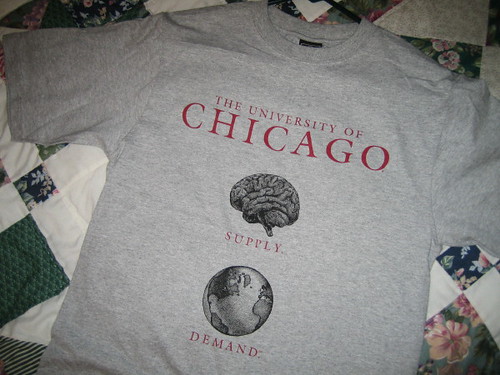
Good to read: The social logic of Ivy League admissions. Not just the Ivies, but the rest of the selective US private institutions do too. MIT's, if you are interested.

UChicagoTShirt

Edit - It seems that Singaporeans will not be eligible for the Rhodes Scholarship effective 2006. I wonder why. Wang Jin (2005) is thus the last Singaporean to be conferred the honor. Joscelin Yeo was the 2004 winner.

Thursday, September 15, 2005

Wandering Scholar(s)

Two months ago, Mr Wang blogged about a PSC scholar wannabe, and how his thoughts (and most likely that also of his peers in the premier junior college in the Bishan-AMK area) is a slap in the face for the local universities' aspirations to become world-class institutions.

Today I read in a Technology magazine about an ex-President's cum Lee Kuan Yew Scholar being selected by a distinguished panel of judges as one of the top technology innovators under age 35 (as of October 1, 2005). Now, don't get me wrong. She definitely did Singapore proud, although I was surprised at her in taking up a faculty position at Caltech. I was expecting her to return to NUS or NTU as a member of the teaching/research staff.

It was only last week that the Economist had published a slew of articles on the state of global higher education. Competition for talent is now global; if you are one, the world will be your oyster, PSC scholar or not.

"Better brain drain than brain in the drain." - Rajiv Gandhi (1944 - 1991), late Prime Minister of India

I have provided a copy of the Economist article (in pdf format) in case anyone had missed last week's issue.

Tracey Ho
Good job, Tracey!