Showing posts with label talent. Show all posts

Sunday, April 08, 2007

Employers' Perception of Local vs Overseas Educated Singaporeans

From the ST forum (Apr 7):

'It's very hard to find good talent in Singapore nowadays,' said HR professional

I ATTENDED a career talk organised by Contact Singapore in Sydney two weeks ago. This event boasted many respectable companies from the banking and financial sector, aiming to give new graduates job opportunities. Overall, the event was informative and encouraging. However, it was marred by an incident that sent shock waves through the conference room.

During the question and answer session, a representative from Morgan Stanley said, 'It is very hard to find good talent in Singapore nowadays' while explaining the need for more 'talent' from overseas. This remark was an insult to every Singaporean attending the event - a verbal slap in the face. It might not have been so offensive had it been a one-to-one talk, but this was an address to an audience of a majority of Singaporeans studying and working in Sydney. The looks on the faces of the Singaporeans present were clear to see. They were of shock, dismay and displeasure.

What is ironic about this incident is that the representative who made the remark happened to be in a senior position in the human resource department of the company. Remind me again what their job scope encompasses? So if this is coming from this part of the company, what does it say about the company as a whole?

I find it ridiculous how local talent is neglected and foreign talent is idolised. Sure, they may have experience from overseas, but are they capable? What can they do that a locally educated person cannot? Surely, they are not worth a quadruple salary compared to a local, simply because they are from overseas. There are some who merit that no doubt, but it is often hastily generalised that employees from overseas are 'foreign talent'. They are foreign but they are not always talent.

Local talent should be recognised and companies that discriminate against the local pool should not be welcome in Singapore. We do not have to take sitting down such disregard for our people. We should never discriminate against our own and we should never allow ourselves to be victimised in any way.

Julian Sng Yeung Liang

Sydney, Australia


Unlike Fox, sometimes I think the problem could be due to the "professionalism of the students before they go for their job interview".

My related previous entry.

Tuesday, January 30, 2007

$10,000 to keep young grads in MA; Strong Inference Method

Just when you think this idea would be staying in just one state, now another is considering a similar version.

As Massachusetts leaders struggle to find ways to stem an exodus of young people from the state, one legislator thinks he has hit upon a solution -- give them money to stay.

...

The stipend would go to anyone who graduated from a state-accredited post secondary school, vocational-technical program, or apprentice program in the last 10 years. The catch: The recipient would have to agree to stay in Massachusetts for at least five years, or repay the money with interest. Also, the graduate's yearly salary could not exceed 135 percent of the community's median income.


--------------------------------------------------------------------

My advisor had the whole group peruse a landmark article by John Platt on "Strong Inference (1964)".

There were certain parts I found to be quite relevant for me to think about on a regular basis.

We speak piously of taking measurements and making small studies that will “add another brick to the temple of science.” Most such bricks just lie around the brickyard (20). Tables of constraints have their place and value, but the study of one spectrum after another, if not frequently re-evaluated, may become a substitute for thinking, a sad waste of intelligence in a research laboratory, and a mistraining whose crippling effects may last a lifetime.

To paraphrase an old saying. Beware of the man of one method or one instrument, either experimental or theoretical. He tends to become method-oriented rather than problem-oriented. The method-oriented man is shackled; the problem-oriented man is at least reaching freely toward that is most important. Strong inference redirects a man to problem-orientation, but it requires him to be willing repeatedly to put aside his last methods and teach himself new ones.


Too often I find graduate students (and smart ones at that), myself included, subconsciously lapsing into the former mode. We try to fit the "problem" to our "methods", and "equipment, calculations, lectures become ends in themselves".

If you are interested to read more, Davis gives a good review of Platt's piece.

Saturday, January 20, 2007

Life starts anew AFTER leaving Singapore; Oh, and jury duty too

I speak from a male Singaporean perspective of course. And no, I am not going to to rant again about how much of a time-and-mind wasting activity National Service is was to most of us. I am just glad that I have the option of not returning and be subjected to wearing that fugly No. 4 (plus whatever push/flavor of the day the gahmen wants the herd to go into).

Oikono (Wharton/Penn), quitacet (Columbia) and 7366 (WashU)'s experiences were very similar to how I felt in my first year away from home. We may all have different dreams, but we chose to come to the US to pursue them (and going beyond grades).

But many Singaporeans do not have this luxury. That nation has done itself in somewhat with the Pygmalion Effect. I am not even referring to some generic compatriot; I looked at the sad eyes of several of my (distant) cousins and neighbors' kids who are not doing well in school, of how their parents (and I am guessing their teachers too) had given up and branded them as 'gone case'.

I do have my teachers to thank for believing in me. Not for some though. And they still leave an imprint on me, albeit in the non-academic sense. I am, in a nutshell, the most confident insecure person you will ever meet. I am still a work in progress. When I was young, I longed to fit in and finally at 21, I stopped trying. I simply went to a new environment overseas. I have not looked back since. Hopefully never ever.

-------------------------------------------------------------------

Insanepoly:

Many of them come brimming with hope and passion. Yet beneath it all, I can’t help but also noticed a lack of self confidence, a lack of belief in their own abilities. Its almost as if deep down they doubt they will ever be able to produce something good. I look into their eyes, I see self-doubts and a fear of failure. Its ridiculous to see some of the students sit infront of their workstation and they’re almost afraid if they do something wrong, the computer will explode or something.

I don’t know why, perhaps its our education system but I don’t for one second believe we don’t have what it takes. Yes, our enviroment may not be condusive for creativity but hell, if flowers can bloom in the desert I don’t see how even an adverse enviroment can stop one from exercising his own creativity. You have to work harder, that’s all. And above everything, you have to believe in yourself. And that’s all it boils down to, if you don’t believe in yourself, that in and of itself is already a major obstacle and perhaps that’s why many people stop improving as an artist. Perhaps its because subconsciously they don’t believe they will be any good, so why bother to practice, why bother to improve. They let the opinions of others beat them down, they let their lack of self confidence bear them down, and that’s sad.


-------------------------------------------------------------------

In my snail mailbox today, there was a letter from the county's "Office of Jury Clerk" addressed to me. First thought that came to my mind - Shit.

Trial by jury is a fundamental principle of our system of justice. Jury service is therefore both an opportunity and an obligation of every American citizen. Your name has been electronically drawn by random selection from a list of residents in this county as a potential juror pursuant to state law. You are being considered for jury service in this county. Your cooperation and willingness to return this form is greatly appreciated.

COMPLETE AND RETURN WITHIN SEVEN (7) DAYS


That was not all. On the envelope enclosed, the top-right hand box has the wording: "Place stamp here. Post Office will not deliver mail without proper postage."

WTF?! 1. I am not a US citizen. 2. You are asking me a favor, and I have to cough up money to send you the stupid form?!

Now, if only I am that lucky in winning the green card lottery...

Thursday, October 05, 2006

More on Mckinsey and the fight for talent

From: (recruiter)@mckinsey.com
Subject: Reminder about McKinsey's Application Deadline: THIS Sunday, October 8th

Dear (university) students,

Thank you for your interest in McKinsey and Company and for attending our presentation a couple weeks ago. We very much enjoyed meeting all of you, and hope we were able to provide you a better sense of who we are and the type of work we do.

Just a reminder about our upcoming application deadline: this Sunday, October 8th. Again, please refer to our website (www.apd.mckinsey.com) to learn more about McKinsey and to submit your application, if you have not already done so.

As someone who was sitting in your shoes three years ago, I would very much encourage you to continue through this application process if you think consulting is a possible career path. By going through the interview process, I really got a much better sense of whether consulting and McKinsey was the right career move for me. And I have to say, I have not looked back for a second in the past two years that I've been with McKinsey!

I also thought I'd pass along a few interesting articles from the McKinsey Quarterly, which contains articles and scholarship by McKinsey consultants on business, non-profit/public and other industries and functions, and general economic topics. With free registration, you can view these articles and some other content online.

This first article, "When Social Issues Become Strategic," argues that executives need to recognize and act upon the role of business in upholding the social contract:
http://www.mckinseyquarterly.com/ab_g.aspx?ar=1763&L2=39&L3=0&srid=246

This second article, "US Hospitals for the 21st Century," discusses some of the key issues facing US hospital systems and future shifts that are needed, and is related to the example engagement I discussed at the presentation:
http://www.mckinseyquarterly.com/article_abstract_visitor.aspx?ar=1824&L2=12&L3=61

This third article, "21st Century Organization" calls into question current corporate organizational models that don't meet the needs of the growing professional workforce that adds value through intagibles such as brands and networks:
http://www.mckinseyquarterly.com/article_page.aspx?ar=1628&L2=18&L3=30

Following our campus presentation, we received thoughtful follow-up questions from many of you. I noticed these questions clustered around a few common themes. So, since it seems you have similar questions on your mind, I decided to share my responses broadly. These thoughts are not meant to be comprehensive or overly detailed. I’m simply passing on a few facts to give you additional insight on McKinsey. If you still have questions, I would be happy to have a conversation with you. Thank you for your interest in McKinsey and for taking the time to get to know us.

Flexibility and work/life balance: McKinsey is committed to helping consultants find a lifestyle balance that works for them and leads to a fully rewarding, sustainable career
-We have formal mechanisms in place to help manage the lifestyle of our teams.
1. At the beginning of a study, most teams hold a “Team Learning” to understand everyone’s personal and professional needs and working preferences. This helps the team form norms that accommodate team member’s lifestyle (e.g. start meetings at 9 AM so people can take their kids to school).
2. Periodically during a study, associates anonymously rate their excitement, satisfaction, and lifestyle in a “Team Barometer”. The team’s responses affect how the team leaders are evaluated and highlight problems quickly so they can be addressed.
-Part-Time programs are available for all consultants and are working well to meet people’s overall needs:
1. At present, ~120 people are on part-time programs. They are among the 740 people who have chosen to go part time at some point in their career.
2. 28 partners and 2 directors have been elected while on part-time programs.
3. We do not have a standard approach to part-time or flexible programs. Everyone is different and has different needs. Some approaches that have worked well include: Reduced hours per week; Reduced weeks per year (breaks between studies); Longer leaves of absence; Temporary or permanent track changes.
4. We continue to experiment with new work approaches for all consultants, such as work sharing, which is currently being piloted in several offices.

APDs are as successful as MBAs at McKinsey.
- We are a merit-based organization, which means you proceed as quickly as you are able.
- In all US and Canadian offices, PhD, MD, and JD candidates are hired for the same position as MBA candidates, at the same salary, and typically advance at similar rates throughout their career at the Firm. This is also true of masters candidates who are hired as associates.
- On average, you can expect to progress to the Engagement Manager role 2 years after joining the firm, Associate Principal 4 years after joining, and Partner 5 – 7 years after joining.
- APDs have partner election rates identical to those of MBAs. We currently have over 300 partners who came to the Firm as APDs.
- We continue to hire increasing numbers of APD candidates because they are so successful at the firm.

Continually supporting your personal growth is one of our core values, and something we have been doing for our consultants for over 80 years.
-We are renowned for the quality of our associate development. In addition to our philosophy of providing real-time “on the job” coaching, we continue to create even more training programs for consultants, including increasing our investment in skill development and mobility opportunities.
1. We spend over $35 million dollars annually on training.
2. New Associates can expect at least 27-46 days of formal, tenure-specific training in their first two years at the firm. Even before your first study, you will spend three weeks at “mini-MBA” training.
3. On-going training is role-specific and focused on building your leadership skills.
-Over 4,000 days of partner time are dedicated each year to reviewing how associates have performed, and sharing this feedback with them in order to ensure that their development needs are met.
-Our staffing process is geared towards developing the full skill set of our consultants
-People leadership (i.e. mentorship/development) is one of the five criteria against which everyone at McKinsey is measured, and is a basis for partner elections. In other words, the Firm chooses leaders who are exceptional mentors.

Forge your own path, make your own McKinsey experience
-There is no single path or cookie-cutter approach to success. We value innovative ideas and people leadership. How you choose to spend your time is up to you.
-McKinsey operates in over 80 offices in more than 40 countries around the world. This global network brings with it an unprecedented amount of variety, which translates into unrivaled choice for our consultants.
-Many of our practices and knowledge initiatives have been started by individuals following their own interests and passions. So if you don’t find a path that suits you at the Firm, we encourage you to create it!
We are looking for people who are passionate about having impact in this world and about developing themselves. If that sounds attractive to you, then WELCOME!

Thanks, again, for your interest in McKinsey.

Best regards,
(Recruiter)


---------------------------------------------------------------

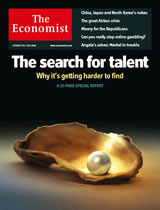
Incidentally, the cover story for the Economist this week is "The battle for brainpower".


You know the fight for talent has gone global when you have Indian software giant Infosys coming to recruit aggressively on US campuses.