Monday, October 16, 2006

Friday, October 13, 2006
Class of XCVI
I am so going to strangle the next person who comes up to me (online) and announces that he/she is going to get married.
Feel just like the old times, you know - on the GCE results day when you saw your classmate(s) going up to the stage because he/she had X number of distinctions more than you and was/were thus the darling(s) of the school/college. But you still had to smile (otherwise people say you sour grapes).
Or how during NSF days you saw your classmates disrupting for their university studies (to prestigious colleges like MIT, Cornell, Michigan, Penn, Oxford, Cambridge etc ) while you were still stuck in camp doing COS duties/signing extras/being pushed around by half-fucked SAF regulars.
Yup, just like those days. Except this time you can hide your true feelings (i.e envy and jealousy) because the other person is informing you through online media like the MSN or email or friendster. And it is so easy to just type out "congratulations!" (when you don't actually mean it) and say "sorry, I won't be able to attend your wedding because I am out of country/in a different state."
Date: Friday, October 13, 2006
Message: How are you? I will be getting married in Dec this year. Will you be in Singapore?
The cold weather's not helping too. 40F. Makes me grouchy. Oh, plus

They are bankers, fast-tracked civil servants, teachers, consultants, lawyers, soldiers...and a grad student.
Guess I won't show up for the upcoming 10th year reunion. F's wedding day is a good time for the gathering. XZ is already sending out emails asking for an opportune time to meet.
-----------------------------------------------------------------------
I don't really care about the rest. Except one, who has yet to declare her date. It took me an awful lot to get over the break-up, but somehow there is this nagging feeling a part of my heart is still with her.
What will I do? How will I feel?
Technorati: love, marriage, couple, class of 96
U.S. Doctoral Education in the 20th Century
A rather comprehensive report (on both Science & Engineering and non-S&E disciplines) released by the National Science Foundation this week.
Highlights include:
* Of the more than 1.35 million doctorates awarded by universities in the United States between 1920 and 1999, 62 percent were in science and engineering fields — but more were given out in education than in any other single discipline in every year from 1962 on.
* Although men received 73 percent of the doctorates throughout the century, the proportion earned by women rose from 15 percent in the early 1920s to 41 percent by century’s end. Among other demographic changes: The proportion of Ph.D.s earned by members of minority groups rose to 14 percent in the period from 1995-99, up from 6 percent in 1975-79. And foreign nationals earned almost one of every three doctorates granted by American universities by the late 1990s, up from one in four just a decade earlier.
* Fifty baccalaureate institutions produced more than a third of the people who went on to earn doctorates between 1920 and 1999. Of those 50 institutions, Oberlin College was the only one that does not itself award doctorates. (Oberlin ranked 35th.) Community colleges played an increasing role in the doctoral pipeline, the report found: More than 11 percent of all U.S. citizens awarded doctorates in 1995–99 had attended two-year colleges, up from about 10 percent in the late 1970s. But the overall proportion of doctorate earners who had attended a community college actually fell to 8 percent from 9 percent, seemingly because of the significant increase in the number of foreigners in the pool of doctorate earners.
* Ph.D. recipients have increasingly had to go into debt to earn their degrees. By 1999, for the first time, more than 50 percent of graduating doctorate earners had accumulated education debt, and the proportion who said they owed more than $20,000 had climbed to 20 percent, up from less than 7 percent a decade earlier.
* That finding may be related to another striking result: The median time it took to complete a Ph.D. (after receipt of a bachelor’s degree) increased from 7 years in 1920-24 to almost 11 years in 1995-99.
More interesting bits in the "historical background" section:
...U.S. doctoral education was in disarray at the turn of the (20th) century. American students were still flocking to European universities for graduate study, and American universities were viewed with little respect by European universities.
The problem was that, unlike in Europe, higher education in America was decentralized and largely unregulated; diploma mills proliferated, and even shaky institutions could call themselves "universities" and award Ph.D.s. Some institutions, for example, allowed Ph.D. candidates to pursue courses without showing up on campus and to take exams at home under supervision of a proctor. The lack of standards and consistency was hurting the reputations of the more demanding U.S. universities. (Speicher 2000)
Now the best and brightest from around the world would want to come to the US for their graduate study.
On a side note, the 2006 Nobels in Science and Econs were all snapped up by American PhDs. The Peace Prize went to a US-trained economist as well.
Technorati: NSF, Science
Monday, October 09, 2006
What I learnt this weekend
Quick roundup:
1. My younger cousin is getting married and the date has been fixed for May next year. I wrote about her elder sister earlier. Naturally, the party on the other end of the line was asking me "when is my turn?" I have no answer.
2. Getting married/settling down in Singapore is expensive. Makes it worse if the bride's mother is insisting on reserving 20 wedding tables just for her side of the family. Then there is the HDB flat which almost everyone I know who got married will 'buy' and go into debt for the next x number of years. Guess they aren't this lucky.
Technorati: love, marriage, couple, cousin
Life Sciences Hub, or Hype?
This has finally made it to the papers. On Today, 9 Oct 2006:
The Life Science Conundrum
After the hype, grads now realise that there’s no place for them in the
industry
Loh Chee Kong
cheekong@mediacorp.com.sg
IN 2002, when Singapore universities had barely begun producing their own life sciences graduates, Mr Philip Yeo, chairman of the Agency for Science, Technology and Research (A*Star), famously rattled those unndergraduates when he said that they would only be qualified to wash test tubes.
But four years on, armed with their Bachelor’s degree, some of these graduates are learning the truth of his words the hard way. Many from the first cohort have ended up in junior research positions or manufacturing
and sales jobs in the industry - positions that do not require a life sciences degree. Others find themselves completely out of the field.
Said Edmund Lim, 27, who graduated two years ago, and now works as a property agent: “One of my classmates is working illegally in Australia, peddling psychotropic drugs to clubbers. Many of my classmates have gone into teaching. Others are in pharmaceutical or equipment sales.”
Another life sciences graduate, who declined to be named, found a job recently at a tuition centre, after failing to land research-related positions for over a year despite numerous job applications.
Already an established base for pharmaceutical manufacturing, Singapore has been trying, in the past five ears, to move beyond manufacturing to more high-end research that is “value-added”.
According to the industry’s annual reviews compiled by A*Star and the Economic Development Board’s Biomedical Sciences Group (EDB BMSG), an average of a thousand new jobs were created annually for the past five years. Last year, there were 10,200 manufacturing jobs in the industry, almost doubling the 5,700 jobs created in the then-fledgling sector in 2001. By 2015, EDB targets the number of such jobs to hit 15,000.
But the booming figures mask a Catch-22 situation: The current shortage of PhD holders in the biomedical sciences cluster is hampering Singapore’s bid to attract multinational companies to move their high-end research projects here. Without a PhD, most of Singapore’s life sciences graduates are only qualified to work as research assistants.
And both graduates and diploma holders vie for these positions that could pay less than $2,000 a month. In the industry’s manufacturing sector, life sciences graduates compete against their peers from other general sciences and engineering disciplines. They face even stiffer competition in the sales sector, where paper qualifications take on less significance.
A*Star’s Biomedical Research Council oversees and coordinates public sector biomedical research and development activities. On the surplus of life sciences graduates, its executive director Dr Beh Swan Gin told Today: “It is not a situation that can be easily communicated, as there are many factors involved. Simply put, a PhD is essential for progress as a researcher. And there are still not enough Singaporeans pursuing PhD studies.”
Adding that the local universities should not pander to the students’ demand for the subject, Dr Beh said: “The job market of today and tomorrow, is the market the universities should focus on. The manufacturing and commercial jobs have always been there, albeit there are more of these now. NUS (National University of Singapore) and NTU (Nanyang Technological University) should get better data on the demand for life science graduates at the Bachelor’s degree level.”
In 2001, NUS’ Science Faculty rolled out an integrated life sciences curriculum and NTU started its School of Biological Sciences (SBS) a year later. Meanwhile, the polytechnics also introduced more life sciences courses. Thousands of students jumped on the bandwagon, with demand outstripping the supply of places in these courses.
Professor Tan Eng Chye, NUS’ Dean of Science - who believes that it could take another five years for the industry to establish itself - acknowledged that his school’s intake of life sciences undergraduates was “a bit too high”.
“When we started offering a major in life sciences in 2001, 550 students took up the programme. For the subsequent intakes, the number stabilised at about 450. But we would be more comfortable with about a hundred less,” said Prof Tan, who added that many students were “unrealistic” about their job prospects.
Said Prof Tan: “A lot of students were probably all hyped up to look for R&D jobs. And when they can’t get such jobs, they could be disappointed. If they want to do research, they should further their studies.”
Nonetheless, some headhunters, like Kelly Services’ Lita Nithiyanandan, predict that it is “only a matter of time” before these “highly valued” graduates find willing employers. Said Ms Nithiyanandan: “As most of these multinational life sciences companies have recently set up or moved their R&D centres to Singapore, they require senior and experienced research professionals at this stage to streamline operations and get compounds approved fast for clinical trials. Once these centres are more established they will definitely need fresh graduates for researching new compounds.”
She added: “Overall, Singapore’s biomedical scene is evolving as a mature hub for Asia Pacific. This would create opportunities across the board for skill sets through the value chain from fresh graduates to mid-level research and analysts to high-end PhD professionals.”
There aren't that many (industry) jobs at the PhD level in the bio sector too. The research's hot, and many (US) professors can get the funding they need. But that doesn't translate into jobs for the doctoral graduates in the US. Many will end up doing post-docs for many years.
I should know - looking at my PhD friends in the (pure) life science majors. The ones having the best and most offers are the Mechanical, Chemical and Electrical engineers.
(Exclude mgt consulting and i-banking.)
---------------------------------------------------
More: mollymeek and sgentrepreneurs.
Fools rush in where angels fear to thread.
Technorati: life science jobs
Thursday, October 05, 2006
More on Mckinsey and the fight for talent
From: (recruiter)@mckinsey.com
Subject: Reminder about McKinsey's Application Deadline: THIS Sunday, October 8th
Dear (university) students,
Thank you for your interest in McKinsey and Company and for attending our presentation a couple weeks ago. We very much enjoyed meeting all of you, and hope we were able to provide you a better sense of who we are and the type of work we do.
Just a reminder about our upcoming application deadline: this Sunday, October 8th. Again, please refer to our website (www.apd.mckinsey.com) to learn more about McKinsey and to submit your application, if you have not already done so.
As someone who was sitting in your shoes three years ago, I would very much encourage you to continue through this application process if you think consulting is a possible career path. By going through the interview process, I really got a much better sense of whether consulting and McKinsey was the right career move for me. And I have to say, I have not looked back for a second in the past two years that I've been with McKinsey!
I also thought I'd pass along a few interesting articles from the McKinsey Quarterly, which contains articles and scholarship by McKinsey consultants on business, non-profit/public and other industries and functions, and general economic topics. With free registration, you can view these articles and some other content online.
This first article, "When Social Issues Become Strategic," argues that executives need to recognize and act upon the role of business in upholding the social contract:
http://www.mckinseyquarterly.com/ab_g.aspx?ar=1763&L2=39&L3=0&srid=246
This second article, "US Hospitals for the 21st Century," discusses some of the key issues facing US hospital systems and future shifts that are needed, and is related to the example engagement I discussed at the presentation:
http://www.mckinseyquarterly.com/article_abstract_visitor.aspx?ar=1824&L2=12&L3=61
This third article, "21st Century Organization" calls into question current corporate organizational models that don't meet the needs of the growing professional workforce that adds value through intagibles such as brands and networks:
http://www.mckinseyquarterly.com/article_page.aspx?ar=1628&L2=18&L3=30
Following our campus presentation, we received thoughtful follow-up questions from many of you. I noticed these questions clustered around a few common themes. So, since it seems you have similar questions on your mind, I decided to share my responses broadly. These thoughts are not meant to be comprehensive or overly detailed. I’m simply passing on a few facts to give you additional insight on McKinsey. If you still have questions, I would be happy to have a conversation with you. Thank you for your interest in McKinsey and for taking the time to get to know us.
Flexibility and work/life balance: McKinsey is committed to helping consultants find a lifestyle balance that works for them and leads to a fully rewarding, sustainable career
-We have formal mechanisms in place to help manage the lifestyle of our teams.
1. At the beginning of a study, most teams hold a “Team Learning” to understand everyone’s personal and professional needs and working preferences. This helps the team form norms that accommodate team member’s lifestyle (e.g. start meetings at 9 AM so people can take their kids to school).
2. Periodically during a study, associates anonymously rate their excitement, satisfaction, and lifestyle in a “Team Barometer”. The team’s responses affect how the team leaders are evaluated and highlight problems quickly so they can be addressed.
-Part-Time programs are available for all consultants and are working well to meet people’s overall needs:
1. At present, ~120 people are on part-time programs. They are among the 740 people who have chosen to go part time at some point in their career.
2. 28 partners and 2 directors have been elected while on part-time programs.
3. We do not have a standard approach to part-time or flexible programs. Everyone is different and has different needs. Some approaches that have worked well include: Reduced hours per week; Reduced weeks per year (breaks between studies); Longer leaves of absence; Temporary or permanent track changes.
4. We continue to experiment with new work approaches for all consultants, such as work sharing, which is currently being piloted in several offices.
APDs are as successful as MBAs at McKinsey.
- We are a merit-based organization, which means you proceed as quickly as you are able.
- In all US and Canadian offices, PhD, MD, and JD candidates are hired for the same position as MBA candidates, at the same salary, and typically advance at similar rates throughout their career at the Firm. This is also true of masters candidates who are hired as associates.
- On average, you can expect to progress to the Engagement Manager role 2 years after joining the firm, Associate Principal 4 years after joining, and Partner 5 – 7 years after joining.
- APDs have partner election rates identical to those of MBAs. We currently have over 300 partners who came to the Firm as APDs.
- We continue to hire increasing numbers of APD candidates because they are so successful at the firm.
Continually supporting your personal growth is one of our core values, and something we have been doing for our consultants for over 80 years.
-We are renowned for the quality of our associate development. In addition to our philosophy of providing real-time “on the job” coaching, we continue to create even more training programs for consultants, including increasing our investment in skill development and mobility opportunities.
1. We spend over $35 million dollars annually on training.
2. New Associates can expect at least 27-46 days of formal, tenure-specific training in their first two years at the firm. Even before your first study, you will spend three weeks at “mini-MBA” training.
3. On-going training is role-specific and focused on building your leadership skills.
-Over 4,000 days of partner time are dedicated each year to reviewing how associates have performed, and sharing this feedback with them in order to ensure that their development needs are met.
-Our staffing process is geared towards developing the full skill set of our consultants
-People leadership (i.e. mentorship/development) is one of the five criteria against which everyone at McKinsey is measured, and is a basis for partner elections. In other words, the Firm chooses leaders who are exceptional mentors.
Forge your own path, make your own McKinsey experience
-There is no single path or cookie-cutter approach to success. We value innovative ideas and people leadership. How you choose to spend your time is up to you.
-McKinsey operates in over 80 offices in more than 40 countries around the world. This global network brings with it an unprecedented amount of variety, which translates into unrivaled choice for our consultants.
-Many of our practices and knowledge initiatives have been started by individuals following their own interests and passions. So if you don’t find a path that suits you at the Firm, we encourage you to create it!
We are looking for people who are passionate about having impact in this world and about developing themselves. If that sounds attractive to you, then WELCOME!
Thanks, again, for your interest in McKinsey.
Best regards,
(Recruiter)
---------------------------------------------------------------
Incidentally, the cover story for the Economist this week is "The battle for brainpower".
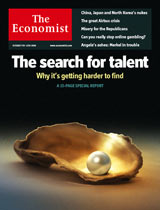
You know the fight for talent has gone global when you have Indian software giant Infosys coming to recruit aggressively on US campuses.
Wednesday, October 04, 2006
Note to Self
When speaking to the girl you are interested in, stop being so self-conscious! Furthermore, the operating principle of the SEM is a completely neutral topic and is a piece of equipment that you are so throughly familiar with.
Granted, you were trying to explain that to her in Mandarin, but she had already said it was OK to describe in English. Why did you make a clown out of yourself by continuing to "hee-haw" in Chinese?
It is no wonder she left the conversation with a puzzled look, and will probably question how you can call yourself an expert user.
*Shakes head*
takchek, you are such a klutz.
Saturday, September 30, 2006
If you want to use Craigslist to look for sex...
...you are more likely to succeed if you are a "straight female looking to have sex with a male". I assume that the local chat rooms (IRC?) will have the same phenomenon happening. (Ed: The survey had excluded gays and lesbians.)
Tells you a lot about the differences in social behavior approach to sex between straight males and females.
Thursday, September 28, 2006
Econs Professors' Blogs
Econs was my minor in (undergrad) college, and in one of my classes I used Greg Mankiw's classic introductory textbooks.
Am surprised to come across his blog. A recommended read. Then there's also another economist professor's blog - Andrew Samwick.
Wednesday, September 27, 2006
"Lowest lifeform in the Universe"
Partially inspired by Mr Wang's entries on NS, as well as Oikono's piece about conscientious objection, I logged on to Amazon last week to buy "The SAFTI Military Institute (Singapore): To Command".
I love those pictures - they remind me of the time when I actually believed in National Service (and sweated out in the field); and the whole shebang about Duty, Honor and Country. I only have one photo from my NS days. The formal one of my BMT platoon. And no, I don't intend to wear my No.4 ever again.
Can you imagine saying something like this?
We are Officer Cadets of OCS
To inspire us onwards as officers to be
We now state with reference and respect
The Officer's Creed
I am an officer of the Singapore Armed Forces
My Duty is to Lead, To Excel and To Overcome
I lead my men by example
I answer for their training, morale and discipline
I must excel in everything I do
I serve with pride honour and integrity
I will overcome adversity with courage, fortitute and determination
I dedicate my life to Singapore

"You there, cadet."
There are some things you just can't forget. Oh yes, the book serves as a good talking point to my fellow grad students. It presents a sanitized view of a part of my NSF stint.
There was one issue Mr Wang's readers did not address. That of the different kinds of privileges given to NSFs, depending on their rank. Having different messes in camps - for officers and WOSEs, and you can really see the difference between the two. If we are all conscripts, why do we get accorded different levels of privileges based on our ranks?
Like what a friend said during our previous meet-up when I was in Sg: "Bloody hell, outside I am a lawyer called to the bar. While in the camp my CPL rank means that I can't sit with my colleague during meal times because he's a LTA."
Technorati: Singapore, NS
Tuesday, September 26, 2006
Connections, connections, connections
Stating the obvious again (after glancing through Kelvin's entry):
Three of the most elitist (and chummy old-boy-networked) employment sectors in the world U.S are: Academia, investment banking and management consulting. The majority of professors in my field of study hailed from only a handful of schools (where they got their PhDs) - you can count them in one-and-a-half hands. For the remainder who did not, they were most likely to have done their post-docs in one of them. The top i-banks and management consulting firms recruit actively from only about 10+ (< 20) schools in the country.
The entry points into these corridors of power, money and prestige are the universities. Hence the intense competition each year to get admitted into the top colleges.
Readers might want to get this book: The Price of Admission: How America's Ruling Class Buys Its Way into Elite Colleges -- and Who Gets Left Outside the Gates. (The author Daniel Golden did a radio interview here.) This reminds me somewhat of the competition to enroll in the top primary schools in Singapore. How parents would 'volunteer their time' or 'donate monies' to the school(s) of choice in order for their kids to get a place, or through 'legacy' admissions (Phase II?).
The only truly 'meritocratic' elite universities in the US are probably the public schools, with the exception of a few private ones like Caltech and Cooper Union. Then again, why should 'academic merit' be the sole 'fair' criterion for admission? If it is, then probably 80% of RJC students would get offered places in the top US private schools every year (with their 4 As and high SAT scores).
Is the world fair? Of course not.
Dan's book had sparked a lively exchange here.
Two groups of people overwhelmingly bear the burden of these policies -- Asian-Americans and poor whites. Asian-Americans are the "new Jews", held to higher standards (they need to score at least 50 points higher than non-Asians even to be in the game) and frequently stigmatised for their "characters" (Harvard evaluators persistently rated Asian-Americans below whites on "personal qualities"). When the University of California, Berkeley briefly considered introducing means-based affirmative action, it rejected the idea on the ground that "using poverty yields a lot of poor white kids and poor Asian kids".
Further readings (scroll to the bottom), and The Economist's Poison Ivy.
Sunday, September 24, 2006
Management Consulting Opportunities
I attended the recruitment talk on campus by McKinsey for APDs. My university is one of their core target schools in the US. For this event, the 11 recruiters/consultants present included 3 alumni who are now Associates with The Firm (to try get us PhDs-to-be to think beyond the typical Academia/Industry pathway and join the dark side). Heh.
Now, I have to think about the hordes of my peers who also showed up for the presentation...

It is the key to leadership.
It is the key to the most influential leadership network in the world: our clients, colleagues and alumni.
Will such doors be even there for me to knock on if I had attended other institutions closer to home?
...I met a friend who graduated from a local university and she is currently working for one of the top management consultancy firms. To my surprise, she told me that she used her junior college as her point of reference (which is the top one) instead of the local university she studied in her CV. According to her, her top JC brand name is likely for her to find a job in a multi-national corporation than using the local university. In addition, she told me that all the students from all local universities are usually eliminated from the first round of their interviews as compared to their counterparts from the other countries. - BL
I see a similarity at the JC level, and wrote about it on a previous entry:
...I was born in Singapore and studied in a neighborhood school (government-run schools catering to students with poorer academic abilities and coincidentally (or not), from lower income backgrounds). Students at my middle school came from lower to middle-class backgrounds. After graduating from middle school, my grades helped me matriculate at one of the top high schools in Singapore, where students were largely wealthier. I could have lived a normal life, oblivious to the poverty and social problems around me… but I failed at this.
At high school, most of my schoolmates, having lived in elite social circles all their life, did not even know that poverty existed in Singapore. Whereas students in my high school had resources and opportunities to dream of attending Ivy League universities, teachers in my middle school told us that we should be grateful if we even made it into a university, much less a renowned university. - oikono
I am not sure about McKinsey in Singapore (although their people profile for SEA featured a Singaporean who got her Bachelors and PhD from Oxford), but I know BCG typically makes only 1 offer each year in Singapore. Several years ago, that went to someone from NUS Law.
Hmm, maybe I should also start looking at the other consulting firms...
(On a side note, all these remind me of Monkey Business and Liar's Poker - all for the shitloads of money and power...)
Thursday, September 21, 2006
Carrots for returning home
What a coincidence to see PS's entry:
...But of course I’m not bitter, not even when my dad feels like he has to entice me to get married by offering to ease off giving a portion of my salary to my parents. 50% reduction if I marry, he says, and 100% cessation if I marry a nice Chinese boy in Singapore. Kinda similar to the government’s tactics to try encourage Singaporeans to have babies, by giving them tax breaks, no?
Sweet deal, but try beating this:
"...I will GIVE you the house if you come back to work and settle down (Ed: with a nice Sg Chinese girl) in Singapore."
Note: A HOUSE (in a choice location no less), although not a detached one. :)
Haha, I can really forget about doing the stereotypical Singaporean way of proposing by asking my other half to get a HDB flat. Not that I want to (buy a HDB) anyway.
Good deal? Look at the terms first. It is really like those Sg govt. scholarships - they come with bonds.
Sigh. Or rather, bleahz.
Edit (24 Sep): jhuprincess' take on this issue.
Wednesday, September 20, 2006
Check out your competitors if you are entering the academic job market
Taken off the Chronicle:
Who's Hot? Who's Not?
From the issue dated September 22, 2006
Online rumor mills shine a light on faculty job searches but may also intensify the star system
By ROBIN WILSON
With 11 campus interviews and an offer from Yale University, Susan D. Hyde quickly emerged as the darling of last year's faculty job market in international relations.
Her good fortune was clear to anyone with an Internet connection, courtesy of a new blog that tracks jobs in her discipline. Through anonymous postings, the blog followed Ms. Hyde's nearly every move, from her interviews at the University of Virginia and George Washington University to her decision to accept the offer at Yale.
Too bad I can't find (yet) a rumor mill for my discipline.
-----------------------------------------------------------
ONLINE RUMOR MILLS IN ACADEME
IR RUMOR MILL
http://irrumormill.blogspot.com
Started January 2005. The international-relations blog lists fellowships and faculty job openings and offers discussion forums. On the forums this year, posters have asked whether some candidates got job offers because they were female, and whether candidates' political views influence departments' hiring decisions.
AMERICAN AND COMPARATIVE JOBS
http://americanandcomparativejobs.blogspot.com
Started May 2006. The politics blog will follow its first full job season this year — from advertisements in the fall to offers in the spring — with separate listings for American politics and comparative politics. Postings on the comparative section started in August this way:
Anonymous: "Good luck to everyone on the market. May the best scholars win."
Anonymous: "Are you joking? The market is seldom just about quality of research."
MIDDLE EAST HISTORY ACADEMIC POSITIONS (THE RUMOR MILL)
http://mideast-history-jobs.blogspot.com
Started July 2006. The blog, begun by a doctoral student in the field, offers job listings plus an overall 2007 job-discussion forum. "Please comment here," it says, "if you wish to discuss (or, most likely, complain about) the 2007 job market."
POLITICAL THEORY AND PUBLIC LAW JOB MARKET
http://politicaltheoryrumormill.blogspot.com
Started January 2006. The blog has separate listings for jobs in political philosophy, political theory, and public law. It also tracks moves by senior scholars in those fields.
ASTROPHYSICS JOBS RUMOR MILL
http://www.hp-h.com/b/astromill
Started in 1999. A sophisticated Web site, known as the "astromill," that offers a color-coded listing of jobs for postdoctoral fellows, assistant professors, full professors, and department heads. Job rumors are submitted by e-mail to an anonymous moderator at edwinhubble@hotmail.com (named after Edwin P. Hubble, the astronomer).
ASTROPHYSICS JOB RUMOUR MILL
http://cdm.berkeley.edu/doku.php?id=astrophysicsjobs
Started July 2006. Martin White, a physics professor at the U. of California at Berkeley, started this wiki to provide the same kind of information as the established astromill, but faster. Because the wiki — a communal Web site — can be edited by anyone with a computer, the information does not have to go through a single moderator. The site uses a single, easy-to-read table to follow openings for tenure-track jobs.
THEORETICAL PARTICLE PHYSICS JOB RUMOR MILL
http://particle.physics.ucdavis.edu/rumor/doku.php
Started 1995. John Terning created the site with a colleague when he was a postdoctoral fellow in physics at Boston U. Now an associate professor at the U. of California at Davis, Mr. Terning still runs it. Above its easy-to-read listing of faculty job openings, the Web site includes this disclaimer: "The following information is based on rumors submitted by our correspondents from around the world. Since many physics departments will not verify this (in principle) public information, we cannot guarantee that any information is accurate. This information is provided as a public service, no warranty is expressed or implied. Your mileage may vary."
UVa's Boy Wonder
Someone should send this article to those 'scholarship' administrators in Singapore. You know, make their scholars complete their undergraduate degrees in one year or less.
Probably with a slogan like: "If Bahn can do it, so can you!"
U-Va.'s One-Year Wonder
Teen Graduates Early, With a Double Major
By Susan Kinzie
Washington Post Staff Writer
Wednesday, September 20, 2006; Page A01
And you thought your kid was smart.
David Banh, an 18-year-old from Annandale, just graduated from the University of Virginia in one year. With a double major.
His college education, almost entirely covered by a patchwork of scholarships, cost him about $200. And he sold back textbooks for more than that. Now he's starting graduate study at U-Va. with a research grant.
So at this point, he's technically running a profit.
He's upending two trends: Most students take longer to graduate than you might think -- about two-thirds of freshmen at four-year colleges in Virginia manage to finish within six years. And tuition gets more expensive every year.
He was helped by the fact that U-Va., as a public school, costs a lot less than most private colleges. And that the university accepted many of his Advanced Placement credits from high school; many of the most selective private schools wouldn't. As it was, he doubled up on course credits and took more physics over the summer to finish his second major.
Read the rest here.

Tuesday, September 19, 2006
What to do with a my Ph.D
Probably too late into the PhD game to be asking myself this question again, but it has been bugging me for the past several weeks.
Several of my classmates have started/about to start interviewing with companies coming to recruit on campus.
Academia doesn't seem so attractive after all. Do I want to continue to work like this?
The National Labs are in sort of a half academia-half industry position, and most folks there are hired straight out from their post-doc stints.
You think Grad School is tough? Wait till you become a tenure track asst. professor. - Prof Anonymous X
Grad school was easy compared to being an asst. prof., by far the worst time of my life.
Pretty much the same hours in the lab, but in addition I also had to teach freshman chemistry and/or graduate courses, write papers and grant proposals, serve on committees, and of course teach brand new grad students how to work in the lab, all the while being scared @#$%less that my career was going down the tubes. Not fun. I literally did not bother to turn on the heat in my apartment, even in dead of winter, because I only spent about 30 waking minutes a day there. My landlord couldn't believe his luck.
But that princely asst. prof. salary more than made up for it all...-SRC
Academia vs. Industry, Academia vs. Industry, Academia vs. Industry, Academia vs. Industry, Academia vs. Industry...
Edit (20 Sep): I love this shit -

Taken from here.
and of course the Scientific Method that we are all too familiar with...

from phdcomics.com
Saturday, September 16, 2006
Sg employers Recruiting Overseas Sg students
To tie in with Mr Wang's and Fox's entries. Email from PSC to recruit overseas Sg students.
Courtesy of loiseaurebelle. (In case you are wondering, this was sent out by the University of Michigan's SSA.)
Hi
There will be two recruitment talks taking place in October:
1. Officials from the Public Service Commission Secretariat will be
hosting an interaction session on 17 October (Tuesday) at 4 pm on
campus to introduce the new initiatives and opportunities available in
the Singapore Civil Service. These include the Mid-term Scholarships
and the Civil Service Internship Programme which are available to
non-scholar undergraduates.
If you are keen on finding out more, please RSVP to Ms Chai Lee Yee,
Development Executive, Public Service Commission Secretariat at
chai_lee_yee (at) psd.gov.sg before 18 September. Refreshments will be
provided and details of the venue will be confirmed later.
2. Contact Singapore, in collaboration with the Monetary Authority of
Singapore, is organising a series of recruitment sessions for some
Singapore-based banks across cities and campuses in the USA. They will
be at Chicago on 20 October. You can consider making a stop there on
the way to Wisconsin, which is where the Midwest Festival will be held
on 21 October. For more information and to register, go to
http://www.dbserver2.com/contactsg/.
So, make yourself valuable to the country by not studying in the local institutions of higher learning.
Technorati: Singapore, education
Monday, September 11, 2006
On the SAF's Utilization of Manpower (for NSFs and NSmen)
Much has been said about the various aspects of NS (I, II) over at Mr Wang's blog.
Mr Wang talked about the SAF's limited ways in taking into account NSFs' preferences and strengths when deciding on their unit postings. Unfortunately for many of the combat vocations in the Army (where the bulk of the NSFs end up in), all they want is a fit body which can run (IPPT/SOC etc) and fire a M16 rifle (or is it SAR21?). Not much leeway there.
There is usually a better fit on the Service/Technical side. Depending on your academic/professional background they actually monitor your work/posting even if you are just a lowly NSF/NSman.
Take for example a NSF project clerk, who OOCed from OCS and was downgraded and posted to a Formation HQ. CPC would actually send out something like this to the Unit he was posted to:
CPC
Depot Road
Singapore
XX Jun 9X
Hd MP (G1 Br), HQ SAF
Project Clerk
1. 1234567H PTE takchek has been posted to HQ SAF as Project Clerk with effect from XX Jun 9X.
2. His HSP is 4 'A' distinctions. Besides the usual clerical duties that he has to perform, he has to be placed on project work, in accordance with the management scheme to employ NSF non-combat fit 4 'A' Level distinction holders in project work.
3. We would appreciate it if you could forward details on the current as well as future projects to be undertaken by the serviceman.
4. Unit is also to monitor his work performance and give a detailed report to CPC on his task and performance in 6 months' time (by 31 Dec 9X) after his posting. Project Clerks who are underutilized will be redeployed to other units which have requests for them.
5. You reply on paragraph by XX Month 9X is appreciated, please.
Signed
Some dude in CPC
I won't go into how I was handling a CPT's (read: executive) work, while holding only a PTE, later CPL rank and getting the (lousy)
---------------------------------------------------------------------
The SAF also tracks doctors. Doctors who were not MOs when they were NSFs.
There are some doctors who become SAF officers through the NS MOCC scheme, which is different from the regular MOCC.
They are doctors who had served their NSF in other vocations/ranks and did not manage to disrupt for their medical course either in NUS or overseas. This was a scheme launched in 95-96. The first batch of NSMOCC commissioned officers graduated sometime in 97/98.
This is the way it worked (then): Mindef and MOH would share their data on the list of registered male medical doctors in Singapore. They narrow down those who did not get their SAF MO commissions during their NSF. These people could be riflemen, storemen, signallers, infantry officers etc. They could even be clerks and be PES E. It doesn't matter. HQMC would arrange to have them transferred from whatever NS units to under their charge for the NS MOCC.
NSMOCC consists of two phases spread out over two years because of ICT restrictions. At least that was the case back then. These guys would be sent to SMM for their NS MOCC course.
Upon completion, they would be commissioned as SAF MOs, and be given the rank of LTA (DR) (NS) for those medically unfit (ie PES C and below), and CPT (DR) (NS) for those PES A/B. Of course the most xiong part the combat-fit guys would have to endure is the IPPT. There is no need to take the SOC.
You might think that it is a good deal, but the truth is that many of these NSmen do not like to go through the course. If nothing else, it lengthens their NS cycle and raises the age limit from 40 to 50 years of age. They would also be given higher appointments to serve in their NS units (read: more sai kang to do). Many of them would rather spend their time outside than to be called back to camp for ICTs and what nots. And imagine being a cadet as a NSman! Yes, even those LTA(NS) officers have to go through the NS MOCC, if they were not MOs previously. They go through with the others who are SGTs, CPLs etc.
Many were unhappy, and some had even asked if it was possible to 'fail' the course and not get their commission. One guy in the first batch did.
BTW, it is almost impossible to 'fail' or go OOC for NS MOCC. That guy failed because of an 'attitude problem'. Almost all of these doctors were in their late 20s to early 30s. Things might have changed now, as my info is (quite) dated.
The main reason for SAF to have this NS MOCC is to better utilize manpower. On the grand scheme of things, it looks good, since you wouldn't want to waste a doctor in wartime to fight as a trooper etc when he can be a MO saving lives.
Some of these doctors were quite happy to go through this course as this gave them a chance to be an officer. Especially for those who wanted to but failed to qualify for OCS when they were NSFs. Or those who went OOC in OCS during their NSF days.
Then there were those who were disappointed. Their main gripe was that SAF wants them to be an officer only when they are qualified doctors outside.
Others complained about having their advanced medical training disrupted, since they were taking some MMed/specialty training courses. There were requests by this group for deferment/disruption etc.
Each NSMOCC cohort numbers around 30-40, although with deferments and disruptions the actual number could be less than 20.
A small number no doubt, but at least the organisation is taking steps to make better use of (skilled) manpower.
---------------------------------------------------------------------
Selected SAF lingo:
CPC - Control of Personnel Center; this is the place where the Army assigns a WOSE (both regulars and NSFs) his vocation and unit
OOC - out of course
OCS - Officer Cadet School
HSP - Highest Standard Passed
NSF - Full time National Service(man)
IPPT - Individual Physical Proficiency Test
HQ MC - HQ Medical Corps
SMM - School of Military Medicine
SOC - Standard Obstacle Course
MOCC/NSMOCC - Medical Officer Cadet Course
WOSE - Warrant Officers, Specialists and Enlisted Men
Technorati: Singapore; NS; SAF.
Tuesday, September 05, 2006
The perennial question for oversea Sg students
Will you stay overseas or return home?
from: Kevin
My take here. Also read loiseaurebelle's entry.
Additional thoughts not already mentioned explicitly earlier:
Reasons to stay overseas1. Pay/Salary
2. Freedom from family control
3. NS
Reasons to return to Sg1. Missing family
2. Availability of nubile, Singlish-speaking Chinese girls chiobus
Unfortunately, being Singaporeans, when you tell them you study in America - They only expect to hear the likes of HYPSM. Otherwise, you must be the type who head overseas because "you cannot make it to the local universities one".
Not just the laypersons, but ones who have tertiary education. And they include people in senior positions in HR who can make decisions on your job application.
Saturday, September 02, 2006
RSAF Open House 2006
Where I went this morning...Paya Lebar Air Base.
Much as I think my 2.5 years of NS was a complete waste of my time, I still regard the RSAF (and to a smaller extent the RSN) highly. Quite professional, and unlike the Army. Oh well, but I won't be staying on this island for long.
More pics:


---------------------------------------------------------------
Technorati: RSAF Open House
Subscribe to:
Posts (Atom)